Sustainability Management
Basic Policy
Based on its corporate philosophy of “contributing to society with the world’s most innovative technology,” the JFE Group will continue to be a company that provides products and services for a prosperous global future for a long time to come. We also consider it our mission to become an organization that is highly regarded by society by striving to play an indispensable role in supporting people’s daily lives, driving sustainable development and ensuring safe, comfortable lives for all. In addition to our initiatives on environmental sustainability, we will also focus strongly on promoting our human resources strategy and human capital management to achieve sustainable growth and enhance corporate value.
JFE Vision 2035—JFE Group’s Aspirations for 2035
Given our goal of achieving carbon neutrality by 2050, 2035 will be a very important year. By this time we should have completed developing and started implementing our carbon-neutral technologies in a full-scale transformation of our business processes. We have determined the following aspirations for 2035 in response to stakeholder concerns over the steel industry’s ability to meet the technological and financial challenges to achieving carbon neutrality and whether JFE will be capable of sustainable growth in the face of intensifying competition across all fronts.
| Become the leader in carbon neutrality (CN) technology development |
|---|
|
| Expand consolidated business profit (Segment profit: ¥700 billion) |
|---|
|
JFE Group Sustainability System
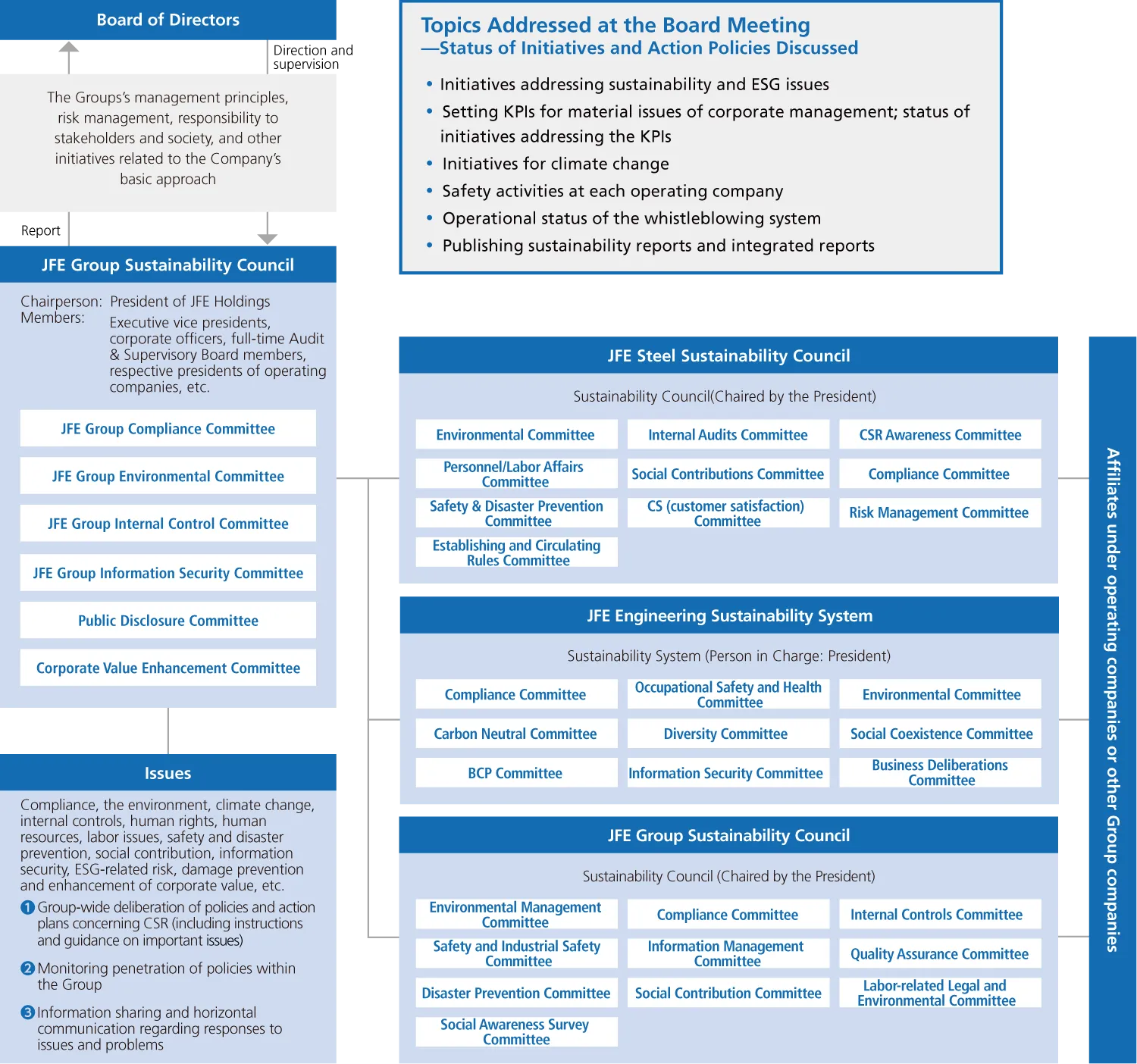
The Group established the JFE Group Sustainability Council, chaired by the president of JFE Holdings and comprised of the Executive Vice President (director), full-time Audit & Supervisory Board members, Corporate Officers, the Presidents of Operating Companies, and other members to oversee and direct the sustainability initiatives of the entire organization, including risk management, from the perspective of preventing damage to the JFE Group’s corporate value and enhancing it. Independent, cross-Group committees have also been established under the council, including the JFE Group Compliance Committee, the JFE Group Environmental Committee, the JFE Group Internal Control Committee, the JFE Group Information Security Committee, the Public Disclosure Committee, and the Corporate Value Enhancement Committee. Overseeing and directing the Group’s sustainability initiatives, these committees deliberate on Group policies, monitor how they are being instilled across the Group, and share information on the tasks at hand as well as on issues that have materialized and relevant responses. Included in the agenda discussed by the JFE Group Sustainability Council, the ’Group’s basic policies, action plans, content of key initiatives and response to critical circumstances are reported regularly to the Board of Directors, which deliberates on the issues and provides the council with direction and supervision.
Activities of the Group Sustainability Council
The Group Sustainability Council meets approximately once every three months to discuss wide-ranging issues such as the antimonopoly act, compliance with laws and regulations to prevent corruption such as bribery involving public servants and other officials, human resources, labor issues, safety, disaster prevention, the environment, climate change, quality, financial reports, addressing antisocial forces, risk management including information security and other ESG-related risks, and social contribution. The council deliberates on policies related to Group initiatives, which also include providing instruction and guidance on material issues, monitors the penetration of the policies, and shares information on and carries out horizontal communication regarding our responses to issues and problems.
Cooperation with Operating Companies
The Operating Companies have also set up respective entities that operate in collaboration with the JFE Group Sustainability Council to promote Groupwide initiatives from the perspective of preventing damage to the JFE Group’s corporate value and enhancing that value. JFE Steel, JFE Engineering, and JFE Shoji are also working to achieve sustainability through the establishment of committees in areas such as compliance, the environment, safety, and disaster prevention.
Diagram of System for Promoting Sustainability
Confirmation and Improvement through the Employee Awareness Survey
The JFE Group conducts a Corporate Ethics Awareness Survey on a regular basis (twice a year starting FY2024) for directors and employees of JFE Holdings and its operating companies to confirm the penetration and thorough compliance of the Group’s Corporate Vision, Corporate Values, and Standards of Business Conduct, along with the identification of potential risks. The survey conducted in FY2024 confirmed that most employees had a good understanding of the Group’s Corporate vision and standards of business conduct, as well as the laws, regulations, and rules related to their work, and that the JFE Group’s Basic Policy on Preventing Bribery of Public Officials and the Guidelines for entertainment and gifts were being adhered to at workplaces. However, while we confirmed that employees are carrying out their work with a high awareness of compliance, the survey also brought to our attention issues to address going forward. The results of the corporate ethics awareness survey and relevant policies were reported at the JFE Group Sustainability Council and Board of Directors meeting in fiscal 2025. Each Group company will continue to implement specific initiatives under the supervision of the JFE Group Sustainability Council and Board of Directors.
During the formulation of the Eighth Medium-Term Business Plan, JFE Holdings’ Board of Directors confirmed that the Group’s Corporate Vision and Standards of Business Conduct remain the unchanging philosophy and unifying force of the JFE Group, 22 years after its founding.
Risk Management
JFE Holdings is responsible for comprehensive risk management in accordance with its Basic Policy to Establish the Internal Control Systems. The JFE Group Sustainability Council, chaired by the president of JFE Holdings, consolidates information and strengthens management across the Group to reduce the frequency and impact of risks.
The executive officer responsible for risk strives to identify potential ESG risks such as those associated with climate change. As necessary, the council confirms and evaluates risks and discusses and determines countermeasures. Key managerial issues are deliberated by the Group Management Strategy Committee.
The Board of Directors supervises initiatives on ESG risks such as those related to climate change and CSR by discussing, making decisions on, and receiving reports about these matters.
Monitoring Method for ESG Risks
Issues that may affect management are monitored by the JFE Group Sustainability Council, Group Management Strategy Committee, and Management Committee. The JFE Group Environmental Committee consolidates information and strengthens management to reduce the frequency and impact of risks and to maximize opportunities.
Group Sustainability Strategy
Formulating the Eighth Medium-Term Business Plan and Revising the Material Issues of Corporate Management
The Eighth Medium-Term Business Plan (FY2025−FY2027) covering the next three years was formulated by backcasting from our JFE Vision 2035, which targets the year 2035. Achieving progress toward the JFE ’Group’s aspirations under this challenging environment will require a greater-than-ever resolve to implement our growth strategy centered on realizing a resilient, streamlined domestic production structure based on a product portfolio that leverages the JFE Group’s strengths, and a business expansion strategy including aggressive investment in overseas growth fields and regions.
We will continue to position climate change as a top-priority business issue and follow the JFE Group Environmental Vision for 2050 to address the issue. Under the Vision, we promote activities for reducing CO2 emissions at JFE Steel and for society as a whole, while also developing technologies to address these challenges as an opportunity for growth. JFE will continue to systematically ensure a stable supply of steel, the core of JFE’s business, to society as an indispensable material for social development and daily life. In formulating the Eighth Medium-Term Business Plan, we also revised the material issues of our corporate management.
Refer to the following on details of the Eighth Medium-Term Business Plan.
Material Issues of Corporate Management
JFE Group’s Materiality under the Eighth Medium-Term Business Plan
The JFE Group’s actions related to management issues are based on identifying materiality and setting KPIs to minimize negative societal impact and maximize societal value by investing JFE Group’s resources from the standpoint of meeting stakeholder needs.
Under the Eighth Medium-Term Business Plan, we identified issues requiring special attention over the next three years for realizing the JFE Vision 2035, while also taking into consideration the issues we have been addressing to date. The issues were extracted from the perspectives of developing a business foundation for sustainable growth and pursuing a growth strategy for achieving the vision. Following a materiality assessment, we identified our material issues of corporate management (16 issues in 6 focus areas).
| Areas of Focus | Material Issues |
|---|---|
| Address climate change issues | (1) Reduce the JFE Group’s GHG emissions and contribute to reducing GHG emissions across society |
| Contribute to the transition to a circular economy | (2) Promote initiatives for realizing a circular economy |
| Acquire robust profitability | (3) Steel Business: Improve sales and manufacturing capabilities, expand and advance business areas |
| (4) Engineering Business: Improve profitability and competitiveness, promote investment in growth areas | |
| (5) Trading Business: Revitalize the management foundation, advance insider status in overseas growth markets | |
| Ensure occupational safety and health for employees | (6) Prevent workplace accidents |
| (7) Promote health and productivity management | |
| Promote human capital management | (8) Improve work engagement |
| (9) Promote diversity, equity and inclusion (DEI) | |
| (10) Promote talent acquisition and development | |
| Minimize risks to the business foundation | (11) Respect the human rights of each person involved in our business |
| (12) Ensure adherence to corporate ethical standards and compliance | |
| (13) Provide appropriate quality assurance | |
| (14) Improve the level of information security | |
| (15) Coexist with local communities, society, and nature | |
| (16) Maintain a sound financial structure |
Process for Identifying Material Issues of Corporate Management
During past updates to our medium-term business plans, we have also reevaluated our material issues of corporate management. This time, as we formulated the Eighth Medium-Term Business Plan, we also determined our key material issues through the following process.
We reevaluated our material issues of corporate management under the plan, along with the implementation and results of KPIs set for each materiality.
Refer to the following on how we identified material CSR issues up to FY2020.
Refer to the following on the process we used to identify material issues of corporate management in FY2021.
We formulated a long-term vision targeting 2035 and extracted 28 candidate items for material issues under the Plan from the perspectives of developing a business base for sustainable growth and pursuing a growth strategy for achieving the vision.
- Prevent workplace accidents
- Preserve environmental air and water quality
- Promote health and productivity management
- Reduce disaster risks at production sites
- Respect the human rights of each person involved in our business
- Address aging social infrastructure
- Ensure adherence to corporate ethical standards and compliance
- Ensure employee safety during emergencies
- Provide appropriate quality assurance
- Address economic security risks
- Raise level of information security
- Implement measures for natural and other disasters
- Coexist with local communities, society and nature
- Appropriately disclose information
- Maintain sound financial structure
- Return profits to stakeholders
- Reduce the JFE Group’s CO2 emissions and contribute to reducing CO2 emissions across society
- Widely provide products and services to society by expanding and advancing business areas
- Improve work engagement
- Sustainable manufacturing based on improvement in sales and manufacturing capabilities
- Promote diversity, equity and inclusion (DEI)
- Realize the scope of profits to ensure sustainable growth
- Promote talent acquisition and development
- Expand business through ongoing investment in operating businesses
- Promote initiatives for realizing a circular economy
- Improve operational efficiency and productivity through digital technology
- Improve the competitiveness of products and services through DX
- Balance trade and business profit
We evaluated the extracted issues in terms of their materiality to the JFE Group’s growth and to society and stakeholders and identified the 16 material issues of corporate management under the Eighth Medium-Term Business Plan.
- Prevent workplace accidents
- Promote health and productivity management
- Respect the human rights of each person involved in our business
- Ensure adherence to corporate ethical standards and compliance
- Provide appropriate quality assurance
- Improve the level of information security
- Coexist with local communities, society, and nature
- Maintain a sound financial structure
- Reduce the JFE Group’s GHG emissions and contribute to reducing GHG emissions across society
- Improve work engagement
- Promote diversity, equity and inclusion (DEI)
- Promote talent acquisition and development
- Promote initiatives for realizing a circular economy
- Steel Business: Improve sales and manufacturing capabilities, expand and advance business areas
- Engineering Business: Improve profitability and competitiveness, promote investment in growth areas
- Trading Business: Revitalize the management foundation, advance insider status in overseas growth markets
We set the targets and aspirations for each identified material issue, together with KPIs as management indicators for achieving them. With regard to these material issues, we conduct an annual materiality assessment that includes reviewing the status of KPI achievement and performance, in addition to a reevaluation during the formulation of the medium-term business plan.
Material Issues of Corporate Management (Consideration Process)
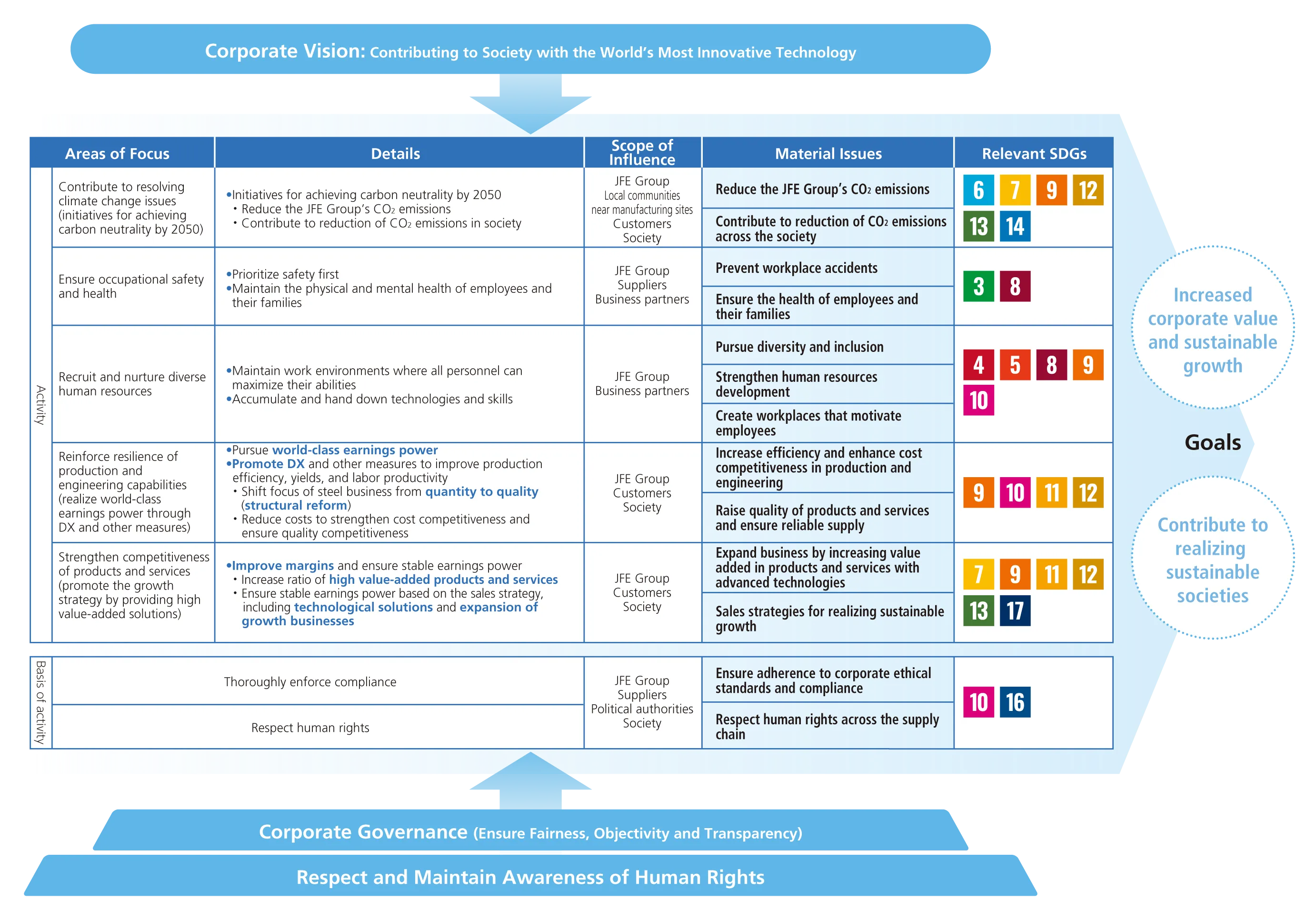
Initiatives to adress Material Issues of Corporate Management
Performance Evaluation for FY2024 KPIs and Establishment of FY2025 KPIs
We assessed the performance of KPIs for FY2024 that were established to address material issues of corporate management identified in FY2021, and established KPIs for FY2025 that correspond to material issues under the Eighth Medium-Term Business Plan, identified through the above-mentioned process. FY2024 performance and KPIs for FY2025 were finalized following discussions by the Management Committee and other organs of each operating company and deliberation by the Group Management Strategy Committee and Board of Directors. Achieving the KPIs will fulfill our corporate social responsibility while also reducing risks that threaten the foundation of management, acquiring robust profitability, and attaining our financial targets.
Initiatives for Improving Financial Indicators
Achieving the financial targets will depend upon enhancing performance as measured by financial indicators that serve as drivers for improvement. intentionally linking each initiative to the financial targets will increase effectiveness and lead to raising medium- to long-term corporate value.
Improving the Sales Revenue Growth Rate
We will seek to expand growth businesses including the “from the inside” model in overseas growth regions and those that contribute to advancing the circular economy. We will also promote activities for increasing sales revenue by designating KPIs that include increases in the ratio of high-value-added products and the number of new products and technologies developed in the steel business and improved project profitability in the engineering business.
Improving the Manufacturing Cost Rate
We will consistently work on enhancing production efficiency and yields to improve the manufacturing cost rate. To drive further improvement through DX, we will designate the number of advanced DX personnel trained as a KPI to bolster our human resources.
Improving the SGA Rate
To enhance labor productivity, we will advance operational efficiency and automation through measures such as core system upgrades in each business. In the steel business in particular, we will manage the initiatives by designating KPIs to measure the contribution to profits from rationalization and higher labor productivity due to core system upgrades, use of data science and automation as well as labor savings achieved in line with the decline in Japan’s labor force and population.
Impact on the Working Capital Turnover Rate and Fixed Asset Turnover Rate
In addition to implementing the above-mentioned initiatives and undertaking appropriate management and use of inventory, we will seek to make improvements by constructing optimal domestic systems, restructuring and integrating businesses, and promoting the use of land owned in the Keihin district. We will also work to expand revenues from solutions services, primarily in the steel segment, drawing upon our accumulated knowledge and expertise as a KPI.
Initiatives and Relevant SDGs
The JFE Group engages in initiatives for achieving sustainable growth for the Group over the medium to long term and enhancing corporate value.
The following chart summarizes all activities introduced in this report. Through these activities, the JFE Group intends to contribute to the achievement of the SDGs.
| Activities | Related SDGs | |
|---|---|---|
| Addressing ESG Issues | ||
|
|
|
|
|
|
|
|
|
|
|
|
|
|
|
|
|
|
|
|
|
|
|
|
|
|
|
|
|
|
|
|
|
|
|
|
|
|
|