Message from the CEO (JFE GROUP REPORT)

The JFE Group aims to fulfill its mission of being essential to society's sustainable development and creating safe, comfortable lives for people everywhere.
JFE Holdings, Inc.
Representative Director, President and CEO
Yoshihisa Kitano
Think, Speak, and Act on Your Own
I became president of JFE Holdings in 2024 and last year's JFE Group Report introduced two mottos I cherish: “Think, Speak, and Act on Your Own,” and “Set Ambitious Goals.” These phrases have been handed down by our forerunners. In the currently challenging business environment, I continue to take these words to heart.
From 2024 to 2025, the Company's business environment grew even more challenging. Japan has been battered by the effects of economic stagnation, diminished global competitiveness across various industries, and lower domestic demand attributable to population decline. Overseas, international market conditions have plummeted due to significant increases in steel exports caused by stagnant domestic demand in China, protectionist trade policies exemplified by U.S. tariffs, and threats to free trade from the emergence of nationalist movements. These and other such developments exemplify the unprecedented difficulties in Japan and abroad facing the business environment surrounding the JFE Group.
In addition, there is the existential problem of climate change. Each time we witness natural disasters caused by extreme weather events, we can feel the wave of global warming bearing down. Aiming to reduce greenhouse gases (GHG) and achieve carbon neutrality is a formidable challenge that we must surmount to ensure humanity can continue living comfortably on this planet. In particular, it is indisputable that for the steel industry, which emits CO2 equivalent to 40% of Japan's industries, action on carbon neutrality is an issue of paramount priority.
As the leader of JFE, which is facing an environment beset by these challenges, I must successfully communicate, both internally and externally, our approach to how the Company will grow and the direction the JFE Group should head.
To ensure the Company can grow, even amid unprecedented challenges in the business environment, I think we must build an organization that can transform itself. During rapid economic growth, a company could grow by aggressively working to achieve the same target (increased production), allowing earnings to rise naturally. We cannot count on that kind of an era. Top management must break free from those kinds of previous successes. To build an organization that can transform itself, each employee must be ever mindful of why the Company exists, remain unsatisfied with the status quo, set ambitious goals, think for themselves about what they will do in their role, and take action aimed at transformation while communicating with those around them. Top management must first make the case for this mindset, and officers need to serve as role models. In addition, I believe diversity or, more broadly, DEI is an important approach to carrying out these actions. By embracing diverse, outside-the-box approaches and creating safe, welcoming spaces to hold discussions, we gained our first insight on transformation and this provides a foothold for the next stage of growth. I feel that our forerunners' phrases—“Think, Speak, and Act on Your Own” and “Set Ambitious Goals”—have grown more important amid this highly challenging business environment.
I want to make JFE a company where employees think about their own businesses, organizations, and individual purposes; envision what they want to be over the long term; set ambitious goals; and strive to achieve them. This sets the stage for how we formulated our Purpose and our long-term vision “JFE Vision 2035.”
Formulating a purpose for each operating company
In our discussions, some people expressed the opinion that we should begin by clearly defining the purpose for JFE Holdings. Then we realized that each operating company supporting the Group also has its own distinct purpose and that, by incorporating the thoughts of their employees, we could formulate a purpose for each of the operating companies.
JFE Steel's purpose is “Dream for your Future, Steel takes you Further.” Yet, the future you will dream of is not obvious. Moreover, the future you dream of may change over the decades. Nevertheless, this purpose represents a commitment to using steelmaking to respond to the futures various stakeholders dream of, such as carbon-neutrality and a society of abundance, as well as customer expectations and employee prospects.
JFE Engineering's purpose is “Create, Care, Connect. The Foundations of Life – Just For the Earth.” The word “connect” includes a concept of the future, and the phrase “just for the Earth” is imbued with the commitment to realize a sustainable society for the Earth and humanity. The purpose includes the unshakeable determination to aspire to a safe and secure society, robustly support people's lives, and pass down the Earth to the next generation.
The purpose of JFE Shoji, which bridges people, goods, and functions to create solutions and new functions, is “Steel and More: Bridging Global Progress.” The word “bridging” incorporates the company's intention to expand the network it has built up worldwide. This expresses a “bridging” function that is unique to general trading companies and includes “Steel and More” because steel is the core business. However, JFE Shoji handles a wide variety of products, so each employee can substitute the word “steel” with whatever product they handle.
I am confident that the purposes of each of the three operating companies accurately represent their true nature.
Aiming to remain essential to society
Striving to transition to a circular economy
Over the 20th century, the global population increased four times from 1.5 billion to 6.0 billion. In 2023, it rose to 8.0 billion and some predict it will eventually hit 10.0 billion. Due to this increase, humanity is being pressured by various issues, including those related to resources, food, the environment, and inequality. To maintain comfortable lives, the three Rs are becoming increasingly important, namely: Reduce to minimize use of the Earth's limited resources, Reuse to extend product lives, and Recycle to effectively use materials in a different form. Awareness of these issues has also raised societal awareness of the need to transition to a circular economy.
The JFE Group has long implemented various initiatives aimed at transitioning to a circular economy, which is considered a strength of the Company. Going forward, the three Group companies will continue collaborating to provide their products and technologies to society.
For example, the steel business has a product lineup connected to the Reduce principle, including high-performance electrical sheets, automotive high-tensile sheets, highly corrosion-resistant sheets, and fatigue-resistant sheets. This can reduce the use of new resources by extending the lifecycle of end products and saving energy through high efficiency. In the steelmaking process, we promote a switch to electric arc furnaces and greater use of steel scrap through conventional blast furnace methods. In addition, by developing technologies that can produce high-quality steel with innovative electric arc furnaces, which will be newly built in Kurashiki, we will broaden the scope of applications for steel scrap and expand the Reuse principle through the transformation of scrap into new products. Expanding the usage of steel scrap helps reduce GHGs by reducing the use of coal. In the engineering business, we promote the Reuse and Recycle principles through businesses that include bottle-to-bottle recycling, plastic recycling, food recycling, and waste-to-energy power generation. The trading business is building a supply chain that will enable these initiatives to spread out across society.
These actions for transitioning to a circular economy form a major framework in the aforementioned JFE Vision 2035 and the Eighth Medium-term Business Plan, which I will go over next. They are crucial when considering the JFE Group's purpose, and I am confident we can continue growing and remain an essential presence by expanding as a business while maintaining financial soundness.
Aims of the long-term JFE Vision 2035
Striving for carbon neutrality in 2050
To date, the JFE Group has unveiled medium-term business plans every three years. This time, however, we also set the JFE Vision 2035 as a long-term target for the next 10 years. The impetus behind this was the Company's aim of achieving carbon neutrality by 2050, meaning 2035 would mark a turning point for completing development of carbon neutral technology and then advancing a large-scale process transformation to adopt those technologies.
We recognize that stakeholders may have two major concerns: 1) whether the steel industry can achieve carbon neutrality in terms of technology and funding, and 2) can JFE actually grow sustainably as competition intensifies across the board. Some employees may feel the same uncertainty. In JFE Vision 2035, we laid out the two goals of becoming the leader in carbon neutral technology development and expanding consolidated business profit (segment profit: ¥700 billion). These goals declare that the Company is facing these concerns head-on and will stand resolute to address them.
We have calculated that in order to achieve carbon neutrality in 2050, we will need investment related to GHG reduction totaling ¥1 trillion by fiscal 2035 as well as an additional ¥4 trillion between fiscal 2036 and 2050. To achieve this, we will need to expand business profit and reinforce our financial standing. As a necessary benchmark for these investments, JFE Vision 2035 sets out a target of ¥700 billion for segment profit in fiscal 2035. This was the first time since its founding that the Group has set a profit target not based on a bottom-up approach.
Breaking down that segment profit target of ¥700 billion, we aim to achieve ¥500 billion in the steel business and then ¥100 billion each in the engineering business and the trading business.
It will be challenging to achieve this profit just by extending our existing methods. We need a major transformation, and investment in growth sectors will be indispensable. To succeed, we must approach this from the three perspectives of 1) selecting and concentrating growth businesses, 2) expanding profit in mature businesses, and 3) enhancing asset efficiency.
The first perspective of selecting and concentrating growth businesses is a strategy of proactively investing in domestic and overseas businesses that have competitive advantages. In the steel business, we position the domestic steelmaking business as the mother mill that serves to develop technology and cultivate human resources for the global rollout of high-value-added products, green steel, and carbon neutral processes. After thoroughly streamlining the business to adapt to the demand environment, we aim to continue investing capital to enhance resilience. Utilizing technological capabilities developed in Japan, we will expand business “from the inside” with top-tier partners in advantageous regions and sectors in the overseas business. We will select regions that offer superior business opportunities and then bring businesses into the Group through M&A and other means as we continue expanding our global supply chain. In the engineering business, we will provide advanced, safe, and secure infrastructure and services from the perspective of realizing a circular economy and reducing GHG emissions. To this end, we will promote an industry reorganization to build a solid earnings and technological foundation, establishing a foothold to becoming a top global player.
With the second perspective of expanding profit in mature businesses, we will think about how to expand the profit of businesses that already steadily generate a profit. We will continue enhancing our earnings power, not only through rationalization and cost-cutting measures within the JFE Group, but also through M&A and collaboration with industry peers.
However, any business that is continually in the red or faces harsh conditions in the near term will need to scale back production by shutting down facilities and undergo reorganization or integration with another company. We realize that in some cases we may need to withdraw from a business or divest it.
The third perspective is enhancing asset efficiency. We will identify assets that are not generating profit and then implement improvement measures. We are engaged in a land utilization business in the Keihin district, which generates profit by utilizing land and buildings left idle after suspending upstream processes, and in a solution business, which earns profit using technologies, capabilities, and know-how we already possess.
We will promote efforts from these perspectives with the aim of steadily achieving our segment profit target of ¥700 billion.
Become the leader in carbon neutrality (CN) technology development
- Complete development of ultra-innovative process conversion technology
- Provide strong technological capabilities and a diverse eco-product lineup to help conserve the global environment
- Become the main player in the high-quality green steel market
Expand consolidated business profit (Segment profit: ¥700 billion)
- Streamlined yet resilient domestic structure based on growth strategies
·Create technologies and nurture talent that drive our competitive advantage
·Deepen our shift from quantity to quality, and reorganize and integrate each business - Growth through the expansion of business in overseas growth regions “from the inside”
·Collaborate with top-tier partners and pursue M&A
The Eighth Medium-term Business Plan
Backcasting from JFE Vision 2035
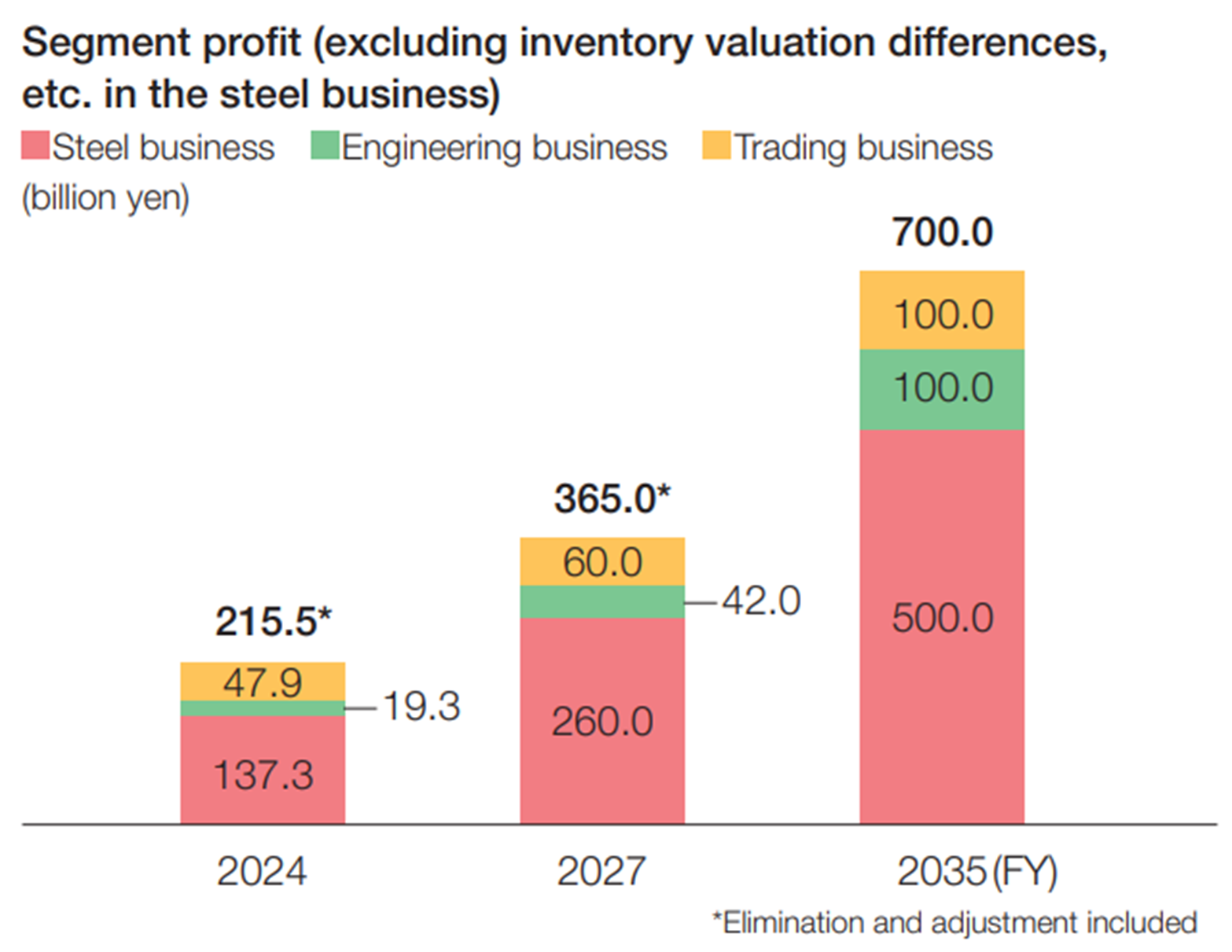
In line with JFE Vision 2035, we formulated the Eighth Mediumterm Business Plan as a growth strategy aimed at achieving the vision. In fiscal 2027, the final year of the plan, we set a target for segment profit of ¥365 billion as a waypoint to ¥700 billion in fiscal 2035. This will be a relatively high watermark compared to the fiscal 2024 result of ¥215.5 billion (including elimination and adjustment, but excluding steel inventory valuation differences).Still, we project that we will be able to achieve this by launching projects already approved for growth investment, rebuilding our domestic structure, and expanding profit in the overseas business. Looking at the entire Group, the domestic business will earn robust profit, but profit expansion in growing overseas markets will still account for a third of our profit target. To achieve the ¥700 billion profit target in fiscal 2035, setting a high target for overseas business expansion will be crucial starting with the Eighth Medium-term Business Plan.
The two axes of the Eighth Medium-term Business Plan are rebuilding a streamlined yet resilient structure in Japan and business expansion that includes aggressive investment in overseas growth fields and regions.
Regarding the steel business, we set out to build crude steel output of 30 million tonnes by the end of the Sixth Medium-term Business Plan (fiscal 2020) and have focused on expanding the production capacity of our steelworks in Japan. When formulating the Seventh Medium-term Business Plan, we perceived an obvious change in trends, such as intensifying price competition in commodity products. We thus abandoned our focus on building a 30-million-tonne structure, making a hard turn toward establishing an optimal domestic production structure. Basically, we began to shift focus from quantity to quality and, through structural reforms of the East Japan Works, created a structure that can turn a profit by producing just 26 million tonnes of crude steel. However, in fiscal 2024 (the final year of the plan), crude steel output decreased to 21.95 million tonnes as demand fell more than anticipated, and we missed our profit target for the year by a wide margin.
Under the Eighth Medium-term Business Plan, we assumed the continuation of a challenging environment, especially in Japan amid forecasts of shrinking demand due in part to longterm population decline. By the end of the final year of the Eighth Plan (fiscal 2027), we aim to achieve a structure that can turn a profit with just 21 million tonnes, 20% less than the current 26 million tonnes. Specifically, we will suspend operation of one blast furnace at the West Japan Works during the period of the current plan. Then, in the first quarter of fiscal 2028 (when the next medium-term business plan begins), we will suspend operation of another blast furnace to switch over to an innovative electric arc furnace. This transition will advance JFE to an optimal structure comprising five blast furnaces and one innovative electric arc furnace. Although it was a tough decision to suspend manufacturing equipment, because the steel industry is a machinery business, it is crucial to adjust production scale to the demand environment. We must continue our transformation into a streamlined yet resilient structure.
To enhance the resilience of our domestic manufacturing bases, we will need to increase the sales ratio of high-value-added products, for which we achieved remarkable results under the Seventh Medium-term Business Plan. We have developed such high-value-added products as the aforementioned high performance electrical steel sheets as well as large and heavy steel plates for offshore wind power generation. We have also conducted capital investment to expand sales of these products. The effects of this investment will soon emerge under the Eighth Medium-term Business Plan. In addition, in the automotive sector, there has been a popular trend to replace general steel sheets with high-tensile sheets to achieve lighter weights, and we have worked hard to develop products that have excellent processability while further enhancing their strength. To achieve solid results in the Eighth Medium-term Business Plan, we will identify fields where demand is growing and link these to the development of our supply structure.
Even overseas, which is our growth engine, we will continue expanding profit going forward by promoting growth investment in regions where demand is expected to grow. In India, we have built a relationship with JSW Steel over more than a decade and, under the Seventh Medium-term Business Plan, decided to jointly operate an integrated production and sales business for grain-oriented electrical steel sheets. Electric infrastructure is expected to expand in India going forward, and we will aggressively capture demand for electrical steel sheets used in transformers as part of our “from the inside” business model. In addition, in North America, we are partnering with Nucor to expand our businesses for automotive steel sheets and construction materials, which are experiencing solid growth. We have built robust partnerships with these companies, both of which are top players in their respective regions. We are successfully combining the strengths of the partners with the Company's technologies and funding. With each company, we will study various ways to steadily capture growing demand as part of our “from the inside” business model in regions where growth is expected.
Similar to the steel business, during the Seventh Mediumterm Business Plan, the engineering business sowed various seeds for growth by investing in strategic projects. Only JFE Engineering is able to mass produce foundational structures (monopiles) for offshore wind power generation in Japan. The Kasaoka Monopile Factory, which came on line in April 2024, is also able to handle ultra-large wind turbines. We expect it to turn a profit under the Eighth Medium-term Business Plan, when a domestic round of project orders begins. In addition, JFE Engineering has strengths in waste-to-energy power plants and the recycling business, overseeing everything from design, procurement, and construction to management and after-sale services. With waste-to-energy power plants, JFE Engineering aims to expand business overseas, especially in Asia, modeled on our track record in Japan. In addition, as a new outgrowth of the food recycling business, we began expanding the business to six sites across Japan with major dining establishments. Under this business model, food waste from restaurants is collected, fermented, and converted into methane gas, which is then used to generate power that is supplied to stores. After fermentation, the remaining residue can be used as fertilizer. Needs for these businesses are expected to rise in line with the transition to a circular economy.
In the trading business, we do not foresee a large expansion in demand in Japan, so it will be crucial to restructure the current logistics sector to be more resilient. We believe the main axis for growth is overseas expansion. In growing regions and sectors, we will continue rolling out our strategy of investing in businesses on a global basis, including through M&A. During the Seventh Medium-term Business Plan, we acquired two companies that process steel sheet construction material: CEMCO (based in the U.S.) and STUDCO (based in the U.S. and Australia). Elsewhere, we founded a company in Serbia for processing and selling electrical steel sheets. Under the Eighth Medium-term Business Plan, we will continue proactively expanding new business with a focus on the key markets of North America, Australia, India, and Europe.
With the Keihin land utilization project, which began under the Seventh Medium-term Business Plan, we will promote land development on a scale never seen before in the Tokyo metropolitan area with the aim of increasing its public use and benefit in line with the already announced OHGISHIMA 2050 plan. Under the Eighth Medium-term Business Plan, we will begin upgrading terminals to receive hydrogen deliveries. Over the near term, the JFE Group will consider not just leasing land but also supplying green power from hydrogen-fueled home power generators and starting a data center business using that power. We will also promote a recycling business, including waste plastics, and promote land use for achieving carbon neutrality and a circular economy.
As for the digital transformation (DX) promoted as a major Groupwide measure, we consider the source of our competitive advantages to be our long accumulated operational data and know-how, as well as technologies born from our wide range of business areas. Continuing from the previous medium-term business plan, we will promote a DX-driven business transformation as well as production and operational process innovation. In addition, we will supply the entire manufacturing industry with world-class manufacturing and process technologies cultivated in the steel business as a solutions business. In the engineering business, we expect new changes for growth going forward, such as using AI to provide solutions to the O&M business, which utilizes our know-how to support its operations.
Mission of the JFE Group
Becoming a leader in carbon neutral technological development
Europe has led low-carbon and decarbonization efforts, but in recent years experienced a series of setbacks as major decarbonization projects were suspended or cancelled due, in part, to uncertainty in policies and soaring energy costs. This has underlined the difficulty, including financial considerations, of realizing a carbon neutral society. Despite this environment, I do not think the overarching trend toward carbon neutrality has changed.
The Japanese government has not changed its position on ensuring the country's industries remain competitive and, in 2025, crafted the GX 2040 Vision to achieve carbon neutrality by 2050. It appears a paradigm shift will occur in the near future, with all products, not just steel, becoming greener. We believe that the Company's continued position as a leader in the development of ultra-innovative technologies and the resulting enhancement of JFE's global presence may help trigger a resurgence in the international competitiveness of Japan's industries, which is currently in decline. Our mission is to work steadfastly to achieve this outcome. Ensuring both environmental and economic viability will be a prerequisite to promoting carbon neutrality, and we have prepared the necessary human resources, technologies, and research facilities. We are confident that these will serve as the basis of growth for the JFE Group.
The JFE Group views this paradigm shift as a chance to take the lead. We will zealously accelerate the development of ultra-innovative technologies for carbon neutrality that ensure both environmental and economic viability as we spearhead the adoption of the developed technologies, connecting them to the production of high-quality steel, which is our strength. We are stepping on the gas internally to finish developing ultra-innovative technologies by fiscal 2035. Though the hurdles are extremely high, we will overcome them somehow.
During this paradigm shift, it will be pivotal to raise public recognition of the environmental value of green steel. Although green steel has already been adopted in some applications, Japanese society as a whole has not yet begun to fully appreciate its environmental value. The steel industry has taken the initiative to spur government action, and in the previous fiscal year Japan's Ministry of Economy, Trade and Industry established the Green Steel Research Team to Promote GX, which unveiled specific support measures that will be needed going forward.
International standardization is further advancing this effort. With overseas demand for green steel expanding, it is important to make its environmental value an international standard, and this is an area where Japan should take the lead. The Japan Iron and Steel Federation has already created guidelines for green steel. Based on them, the World Steel Association announced the worldsteel guidelines for GHG chain of custody approaches in the steel industry in 2024. Next, we are promoting revisions of the GHG Protocol and ISO initiatives. Even with these efforts, it will be important for Japan's steel industry to take the lead.
Initiatives for human resources that support the realization of the long-term vision
Human resources are the driving force of corporate growth
Without the strength of the employees, it would be impossible to achieve either the Eighth Medium-term Business Plan or JFE Vision 2035. To me, it is greatly reassuring that the JFE Group employees are sincere and fully committed to their work.
We are now in the midst of an unprecedented transformation that will see us through the coming era of carbon neutrality. Amidst this, the Company's corporate values remain constant: “Challenging Spirit. Flexibility. Sincerity.” Today, however, I believe “Challenging Spirit” has become especially important as we tackle all manner of challenges. At the top of this message, I mentioned that DEI will prove even more pivotal going forward. We face various issues we have never experienced before: issues that do not have easy answers. These issues are proliferating before our eyes. Broader society and the environment surrounding the JFE Group have changed significantly, including the need for carbon neutrality and successful transition to a circular economy. In this environment, the synergistic blending of employees bringing a wide array of perspectives, owing to their diverse backgrounds, has given us the power to move forward. I believe the JFE Group is prepared to blaze a trail toward its vision.
To this end, my critical mission is to ensure the Company offers an attractive workplace where employees can tap their full potential and thrive. I will continue to help create a rewarding workplace through aggressive investments to assure safety and health while supporting the growth of every employee.
To our stakeholders
Aiming to enhance corporate value
The Company considers share price a key management indicator, and I must regrettably admit that our valuation on the stock market is low. We must raise it. Currently, the Company's priceto-book (P/B) multiple has dropped well below 1.0 times, and we see this as a major issue.
To enhance stakeholders' valuation of the Company, even amid this challenging business environment, we will steadily address the issues set out in the aforementioned JFE Vision 2035 and the Eighth Medium-term Business Plan. We think this will enhance corporate value by stably realizing a return on equity (ROE) exceeding the cost of equity and increasing the trust placed in us by the markets.
Going forward, all of the employees of the JFE Group will continue working as one to address a wide range of issues while striving to enhance governance and ensure compliance so that the Group can remain essential to society's sustainable development as we work to create safe, comfortable lives for people everywhere.
To our stakeholders, I hope that this report will further your understanding of the path I laid out here—the path we are determined to forge—and get you excited about what the JFE Group has to offer for the future.
Representative Director, President and CEO
Yoshihisa Kitano