Corporate Governance
Basic Policy
With the steel business, engineering business and trading business at its core, the JFE Group develops a broad range of businesses in a wide range of areas together with many group companies and partners. Establishing a proper governance system is essential toward improving independence and raising efficiency in each operating company, along with the optimal management of risks, which include those related to the environment, safety, and disaster prevention in the Group. It is also necessary for the sustainable growth of the Group and the medium- to long-term improvement of its corporate value.
With the aim of enhancing the best corporate governance to embody the JFE Groups’ Corporate Vision, the Company has established the JFE Holdings Basic Policy on Corporate Governance. The Company has revised the policy pursuant to its transition to a company with an Audit & Supervisory Committee, as approved at the Ordinary General Meeting of Shareholders held in June 2025.
Results
Major topics discussed during FY2024 Board of Directors meetings included the following.
- Progress of the Seventh Medium-term Business Plan
- Establishment of JFE Vision 2035 and the Eighth Medium-Term Business Plan
- Large-scale investments (construction of a Continuous Galvanizing Line (CGL) at JFE Steel’s West Japan Works (Fukuyama District) , acquisition of interests in the Blackwater coal mine in Australia , etc.), follow-up on investments and loans
- ESG initiatives (e.g., efforts to achieve carbon neutrality, assessment and review of KPIs for material issues of corporate management)
Selected governance data can be accessed from the following link.
Systems and Initiatives
Corporate Governance System
Group Governance System
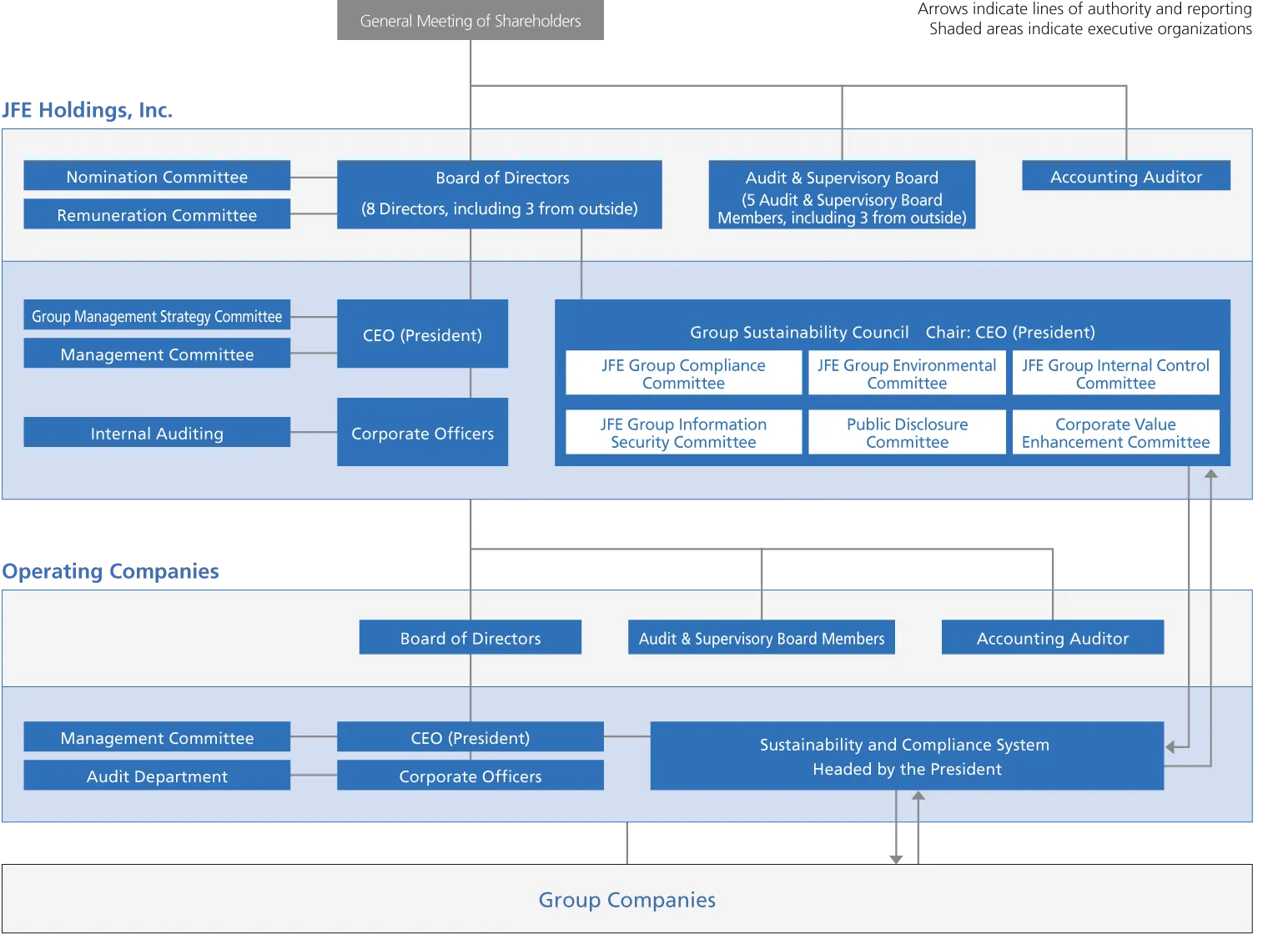
The JFE Group comprises a holding company and three operating companies, JFE Steel, JFE Engineering, and JFE Shoji.
JFE Holdings, a pure holding company at the core of the Group’s integrated governance system, guides Group-wide strategy, risk management, and public accountability.
Each operating company has developed its own system suited to its respective industry, ensuring the best course of action for competitiveness and profitability.
Governance System
The Company has constructed the following corporate governance system aimed at continuously increasing corporate value and the common interest of shareholders by reinforcing the fairness, objectivity and transparency of management. Upon the approval of the Ordinary General Meeting of Shareholders held in June 2025, the Company transitioned to a company with an Audit & Supervisory Committee to further strengthen the supervisory function of the Board of Directors by accelerating decision-making and enhancing the discussion of management policies and strategies within the Board of Directors.
Major Initiatives to Strengthen the Governance System
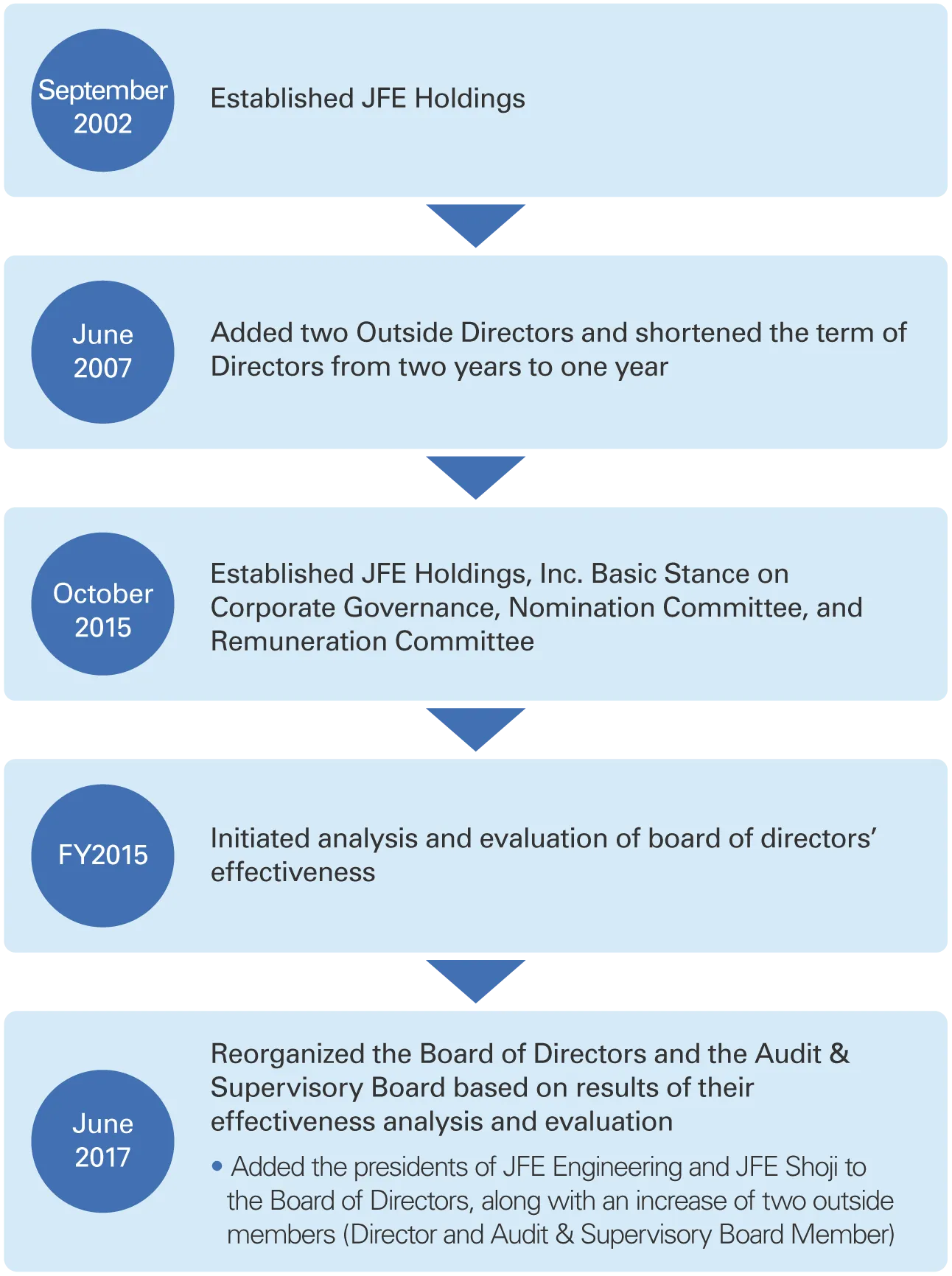
Duties of the Board of Directors and other Bodies
Appointment of Independent Outside Directors
The Company appoints several Independent Outside Directors, ensuring that they make up at least one-third of the Board. Candidates for Independent Outside Director are elected from individuals capable of strengthening corporate governance, such as those with extensive management experience in global enterprises or experts with deep professional knowledge, and who meet the Company’s Standards for Independence of Outside Directors. Currently, 6 of the 13 Directors are Independent Outside Directors.
The Company elects several Independent Outside Directors who are Audit & Supervisory Committee Members. Independent Outside Directors who are Audit & Supervisory Committee Members will be elected from persons who are appropriate to bear the role of enhancing auditing function such as those who possess abundant experience as management in global enterprises or experts who possess profound knowledge, and meet the Company’s Standards for Independence of Outside Directors Currently, of the five Audit & Supervisory Committee Members, three are Independent Outside Directors who are Audit & Supervisory Committee Members.
Approach to Diversity in the Board of Directors
With regard to the composition of the Board of Directors, the Company elects officers following deliberations by the Nomination Committee by focusing on the enhancement of diversity of the Board members, such as their expertise, knowledge and experience in various fields, while balancing with the appropriate size of the Board. The Company also elects Directors who possess a wealth of knowledge and experience as management in global enterprises. In this way, the Company is working to enhance gender and global diversity. Two female Directors are currently in office. The company will continue to systematically engage in initiatives to foster such human resources suitable for candidates for Directors by setting specific targets.
Skill Matrix of Directors
We have established the JFE Holdings, Inc. Basic Policy on Corporate Governance for promoting sustainable growth of JFE Holdings, Inc. and the JFE Group, the medium- to long-term improvement of corporate value, and expressing concretely the JFE Group’s Corporate Vision of pursuing best practices in corporate governance and achieving further development in this area. With regard to the composition of the Board of Directors, we strive to enhance the diversity of the Board members, such as their expertise, knowledge, and experience in various fields, and identify necessary skills of corporate management in light of our business and corporate management issues of the Company and the Operating Companies. The Company elects ates for officers following deliberations by the Nomination Committee while balancing with the appropriate size of the Board. The skills matrix for each Director against identified skills in light of their knowledge, experience, and expertise are summarized below.
| Name | Corporate management / Management strategy |
Sustainability / Environment |
Technology / DX |
Finance and Accounting | Internal control / Governance |
Legal Affairs / Compliance |
Human Affairs / Labor,Human resources development |
Sales / Marketing |
Business that Requires Knowledge | ||
|---|---|---|---|---|---|---|---|---|---|---|---|
| Directors | Inside | Yoshihisa Kitano | ● | ● | ● | ● | Steel | ||||
| Masayuki Hirose | ● | ● | ● | ● | Steel | ||||||
| Masashi Terahata | ● | ● | ● | ● | ● | ● | Steel, Trading | ||||
| Kazuyoshi Fukuda | ● | ● | ● | ● | ● | Engineering | |||||
| Yoshifumi Ubagai | ● | ● | ● | ● | Steel, Trading | ||||||
| Outside | Yoshiko Ando | ● | ● | ● | ● | - | |||||
| Takuya Shimamura | ● | ● | ● | ● | - | ||||||
| Keiichi Kobayashi | ● | ● | ● | ● | ● | - | |||||
| Directors who are Audit Supervisory Committee Members |
Inside | Nobuya Hara | ● | ● | ● | Steel | |||||
| Nakaba Akimoto | ● | ● | Steel, Engineering, Trading |
||||||||
| Outside | Tsuyoshi Numagami | ● | ● | ● | ● | - | |||||
| Yoshihisa Suzuki | ● | ● | ● | ● | ● | - | |||||
| Naoto Nakamura | ● | ● | ● | - | |||||||
(As of June 25, 2025)
Nomination Committee and Remuneration Committee
JFE Holdings has maintained the Nomination Committee as well as the Remuneration Committee, which acts as an advisory body of the Board of Directors to ensure fair, objective, and transparent personnel affairs and remuneration of the Board of Directors. Both committees are composed of a majority of Outside Directors, and their chairpersons are elected from among Outside Directors.
The Nomination Committee deliberates and reports to the Board of Directors on matters pertaining to the basic policies on the election and dismissal of the President of the Company, proposals for the election of candidates for the President of the Company, succession plans of the President of the Company, and the nomination of candidates for Outside Directors. (Four meetings were held in FY2024, all with 100% attendance.) The Remuneration Committee deliberates on matters pertaining to the basic policy on the remuneration of Directors, etc., of the Company and each Operating Company and reports to the Board of Directors. (Five meetings were held in FY2024, all with 100% attendance.)
Support for Directors
A Board of Directors’ Secretariat is set up in the General Administration Dept. to support Outside Directors with necessary communication and arrangements, etc. Furthermore, dedicated staff to support the duties of the Audit & Supervisory Committee, which is composed primarily of Outside Directors who are Audit & Supervisory Committee Members, are allocated in the Audit & Supervisory Committee’s Office.
Directors are provided with opportunities and funding to receive training in legal matters, corporate governance, risk management, and other subjects that help them fulfill their roles and duties.
In addition, the Company provides Outside Directors with briefings, etc. prior to the Board of Directors meetings, and gives materials and explanations on each agenda item.
Furthermore, the Company strives to provide adequate information necessary for execution of their duties by providing explanations on important management issues of the Company and the Group companies from time to time, and offering opportunities such as exchanges of opinions with the senior management including the President, attendance of hearings of important business reporting by each department as necessary, convening of Board of Directors meetings at major business bases and inspections of Group companies, etc. In addition, meetings exclusively for Outside Directors serve as venues for freely exchanging information from an independent, objective standpoint.
| FY2024 Results |
|---|
|
Board of Directors Briefings 12 times Board of Directors meetings convened at major business bases 1 time JFE Steel East Japan Works (Chiba district) Tours of major business bases and Group Companies
Training for Directors
|
Analysis and Evaluation of the Effectiveness of the Board of Directors
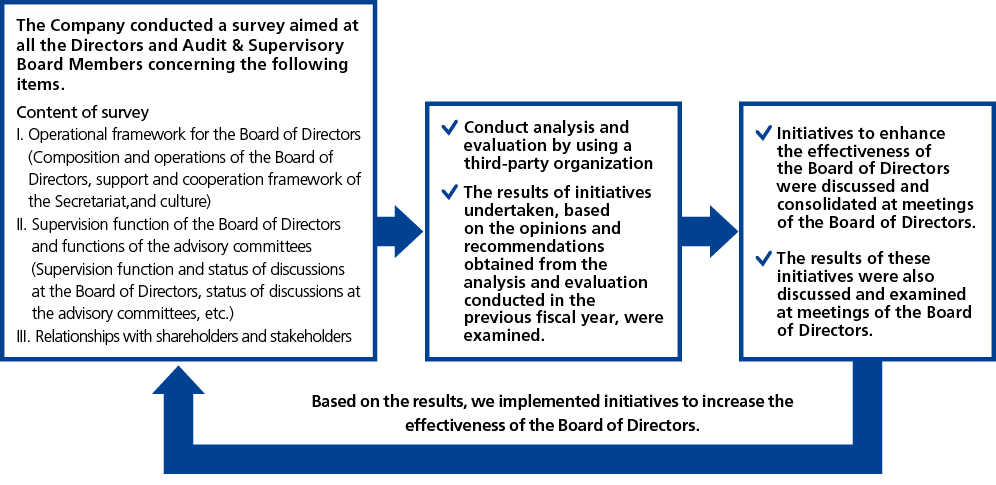
In line with the Basic Policy on Corporate Governance, the Board of Directors of the Company has been evaluating the overall effectiveness of the Board of Directors. The process and results of the effectiveness evaluation are as follows.
The Results of the Effectiveness of the Board of Directors in FY2024
- The overall effectiveness of the Board was ensured through robust discussions among members supported by substantial preliminary briefings at the meeting for Outside Directors and Audit & Supervisory Board Members as well as by appropriate management and leadership by the chairperson.
- The accurate and fair auditing of Directors’ execution of their duties by Audit & Supervisory Board Members
- Audit & Supervisory Board Members’ proactive voicing of opinions and questions regarding the management decision-making and reporting at the Board of Directors meetings have vitalized deliberations at the Board meetings. It was thus determined that the Company is functioning effectively as a company with an Audit & Supervisory Board.
Process of the Evaluation of the Effectiveness of the Board of Directors
Issues Identified in the Evaluation of Effectiveness for FY2023
- Sustainable corporate growth depends upon considering the ideal state of the Group and its long-term strategies while at the same time further deepening discussions on human capital management and respect for human rights as well as other material management issues.
- From the perspective of enhancing corporate value, we must organize the agenda items for Board of Directors meetings to establish a balance between speedy decision-making with supervisory functions. We must also continue to consider the governance structure, including ways to further enhance diversity.
- To further strengthen risk management across the entire Group, we must continuously consider ways to develop our reporting of risk information, including that of subsidiaries and affiliates, to the Board of Directors.
The FY2024 Initiatives
- Reports were made at meetings of the Board of Directors concerning the direction and other facets of the Group’s vision, JFE Vision 2035, together with the Eighth Medium-Term Business Plan, which is its growth strategy for achieving this vision, at each stage of consideration, and the Board of Directors held discussions on medium and long-term corporate value enhancement.
- Reports were made at meetings of the Board of Directors concerning sustainability issues, including the human resources strategy that supports management strategy, DE&I initiatives, the results of engagement surveys and the Company’s response, and progress on the implementation and expansion of human rights due diligence aimed at ensuring respect for human rights.
- The Company conducted surveys to ascertain the status of compliance at Group companies and to support initiatives. The findings and responses to these surveys were reported at meetings of the Board of Directors, and it engaged in discussions regarding risk management.
- The Company decided to transition to a company with an Audit & Supervisory Committee to further strengthen the supervisory function of the Board of Directors by accelerating decision-making and enhancing the discussion of management policies and strategies within the Board of Directors.
Issues Identified in the Evaluation of Effectiveness for FY2024
- Pursuant to the transition to a company with an Audit & Supervisory Committee, the Board of Directors should engage in fuller discussions concerning its vision for the future, including its approach to the delegation of executive authority and the scale and diversity of the Board of Directors.
- In addition to important management issues that are discussed on an ongoing basis, such as human capital management and respect for human rights, the Board of Directors should further enhance discussions aimed at analyzing and improving the Company’s market valuation.
- The Company should enhance reporting to the Board of Directors on risk information, including that of subsidiaries and affiliates, to further strengthen risk management across the Group.
Initiatives will be proactively undertaken to further increase the effectiveness of the Board of Directors and enhance the corporate value of the Group.
Operating System
Key Decision-Making
With regard to significant matters at each company within the Group, internal rules define clear standards and procedures for decision-making. Significant matters concerning overall Group management are ultimately deliberated and decided by JFE Holdings, Inc. Each Operating Company determines important matters related to itself and its subsidiaries through deliberations at the Management Committee and other relevant bodies followed by decisions of the Board of Directors. At JFE Holdings, Inc., the JFE Group Management Strategy Committee deliberates on matters concerning management strategies for the entire Group, while the Management Committee considers specific significant matters related to the Company, the Operating Companies, or Group Companies. Based on these deliberations, the Board of Directors makes final decisions on significant matters in accordance with the Rules of the Board of Directors.
Executive Remuneration
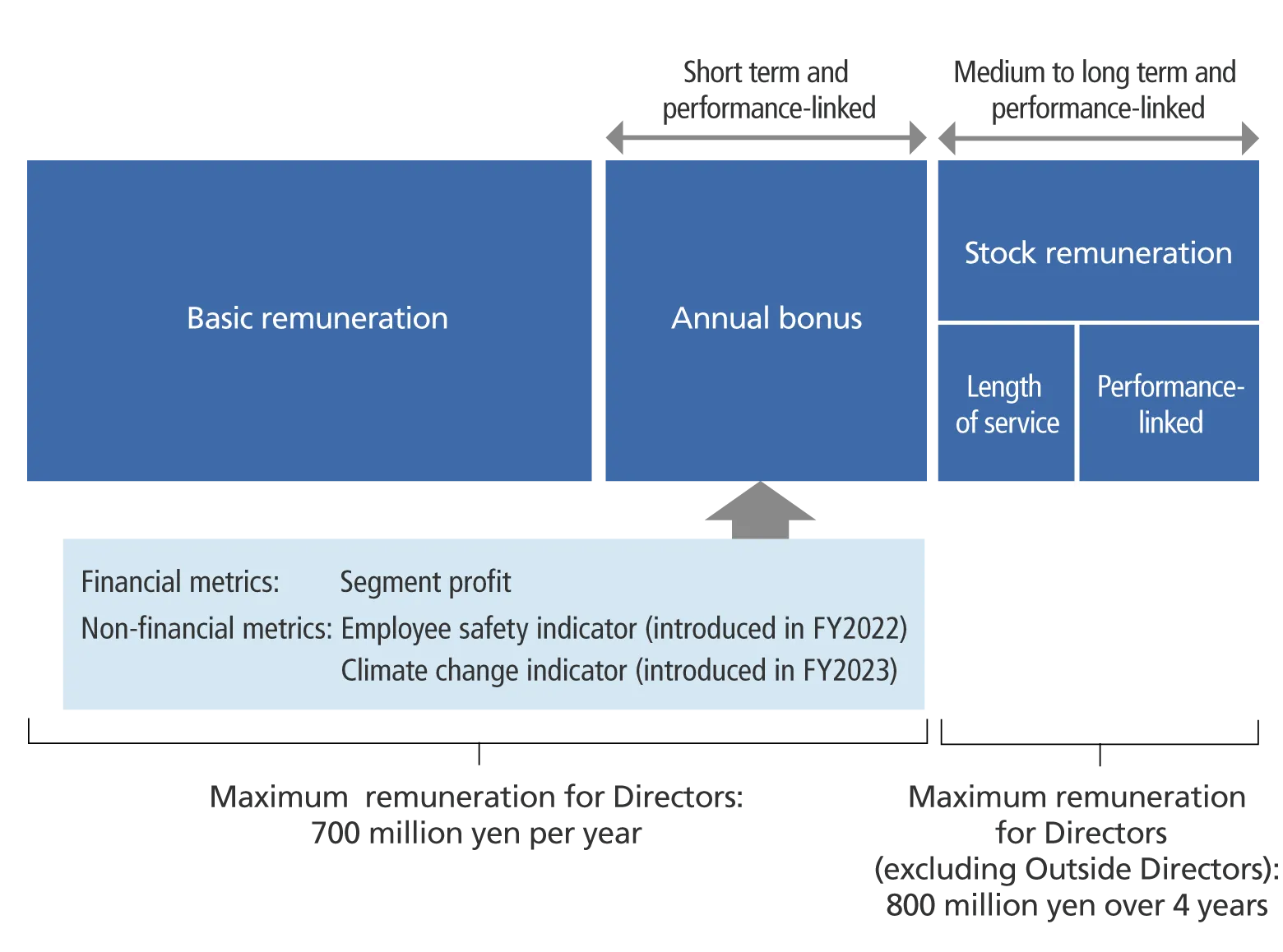
Executive remuneration is based on the Basic Policy on Remuneration for Directors and Corporate Officers and the Policy for Deciding the Individual Remuneration for Directors and Corporate Officers founded on discussions and reports by the Remuneration Committee, and it is decided through either a resolution of the Board of Directors or deliberations by the Directors who are Audit & Supervisory Committee Board Members, for an amount within the total limit approved at the General Meeting of Shareholders.
Basic Policy on Remuneration for Directors and Corporate Officers
- The Board of Directors (excluding members of the Audit & Supervisory Committee; hereinafter the same) shall determine remuneration system for Directors and Corporate Officers based on deliberations regarding its appropriateness by the Remuneration Committee to ensure fairness, objectiveness, and transparency.
- The remuneration level for Directors and Corporate Officers shall be determined to secure excellent human resources who are able to put the Group’s corporate vision into practice, taking into consideration the business environment of the Group and remuneration levels at other companies in the same industry or of the same scale.
- The ratio between basic remuneration and performance-linked remuneration (annual bonus and stock remuneration) shall be properly established according to the roles and responsibilities, etc., of each Director and Corporate Officer so as to function as sound incentives toward the sustainable growth of the Group.
Outline of Policy for Deciding the Individual Remuneration for Directors and Corporate Officers
- Remuneration for Directors (excluding members of the Audit & Supervisory Committee; hereinafter the same) and Corporate Officers shall be determined by a resolution of the Board of Directors in accordance with the Basic Policy and the Decision Policy, based on reports from the Remuneration Committee.
- Remuneration for the Directors and Corporate Officers is comprised of basic remuneration and performance-linked remuneration (annual bonus and stock remuneration).
- Basic remuneration is paid as a fixed amount, in cash, each month according to position.
- An annual bonus is linked to the Company’s single-year performance (calculated based on financial and non- financial indicators) and is paid in cash once a year.
- Stock remuneration is granted as the Company’s shares and cash equivalent to the amount of the Company’s shares converted to market value through the trust upon retirement.
- The ratios of remuneration by type are structured so that the higher the position, the greater the weight of performance-linked remuneration, and the ratio for the Company’s President when performance target goals have been attained is set so that the ratio of basic remuneration, annual bonus and stock remuneration stands at 2:1:1.
The Company pays only basic remuneration to Outside Directors and the Directors who are Audit & Supervisory Committee Members, given their roles of supervising and auditing management from an independent and objective standpoint. Directors who concurrently serve as Executive Directors of operating companies shall not be paid the annual bonus or the Stock Remuneration from the Company.
Furthermore, the calculation method for performance-linked remuneration, as described below, has been revised from FY2025 based on the Eighth Medium-term Business Plan.
Annual bonus
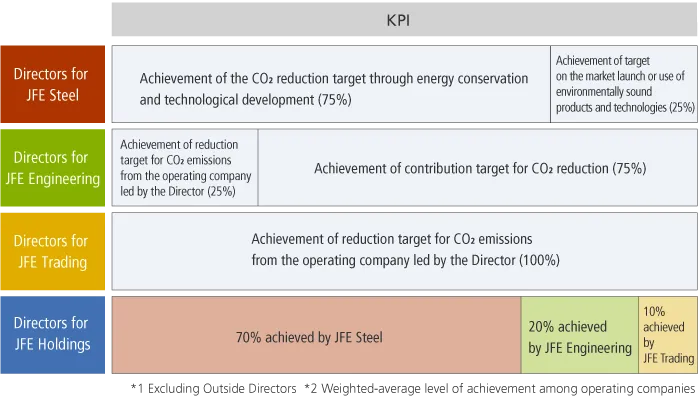
The annual bonus is a remuneration package linked to both financial and ESG performance based on fiscal year results. Financial performance is measured by the total segment profit for a single fiscal year. ESG performance is assessed using the following indicators: employee safety (lost-workday injury rates, with 0% for a fatal accident), climate change (achievement of KPIs related to “Initiatives to Address Climate Change Issues”), and employee engagement (achievement of KPIs related to Enhancement of Job Satisfaction under Promotion of Human Capital Management). Among these, the employee engagement indicator was recently introduced starting in FY2025, recognizing the importance of providing incentives to maximize the capabilities of human resources that drive corporate growth and to enhance job satisfaction. The individual remuneration amount is determined by multiplying the level of achievement of these indicators by a given coefficient for each position.
Directors and Corporate Officers who have been dismissed or have committed any misconduct may lose the right to receive benefits based on a resolution of the Board of Directors. Directors and Corporate Officers who have already received benefits may be asked to return the amount based on a resolution of the Board of Directors if they engage in any misconduct.
Stock remuneration
Under the stock remuneration plan, a payment level is determined based on performance targets set in the Group’s Mediumterm Business Plan, etc. From FY2025, to further promote value sharing with shareholders and increase awareness of contributing to the improvement of medium- to long-term corporate value, we have selected the target values for ROE (10% or more), as set forth in the Eighth Medium-term Business Plan, and relative TSR (1 or higher) as performance indicators for the performance-linked portion. The level of payment is based on the degree of achievement of each indicator.
Directors and Corporate Officers who have been dismissed or have committed any misconduct may lose the right to receive benefits based on a resolution of the Board of Directors. Directors and Corporate Officers who have already received benefits may, based on a resolution of the Board of Directors, be required to return the shares and cash already provided if they engage in any misconduct.
To achieve sustainable corporate growth for the Group, the Remuneration Committee and the Board of Directors continue to improve the remuneration system for Directors to serve as an incentive with a higher level of integrity.
The outline of remuneration system for the Company and Directors (excluding Directors who are Audit & Supervisory Committee Members)
Internal Control
The JFE Group’s internal control system, in accordance with the Basic Policy for Building an Internal Control System, is maintained through various committee regulations including the Rules of the Board of Directors, Regulations for Group Management Strategy Committee, Regulations for Management Committee, Regulations for the JFE Group Sustainability Council, Regulations for Organization and Operations, Regulations for Document Management, Regulations for Addressing Violence Directed at Companies, and a Corporate Ethics Hotline. These regulations are periodically reviewed to ensure their effectiveness.
In addition, we revise and improve the Basic Policy from time to time to boost sustainable corporate value. In line with the transition to a Company with an Audit and Supervisory Committee, as approved at the General Meeting of Shareholders held in June 2025, the Basic Policy for Building an Internal Control System was also revised.
Strengthening Internal Control
Internal Audits
JFE Holdings, its major operating companies, and key Group companies have internal audit organizations comprising 179 people as of April 1, 2025. These organizations share information to enhance overall auditing within the Group. They also report internal audit plans and findings to the Board of Directors, the Audit & Supervisory Committee, and the JFE Group Sustainability Council on a regular basis to maintain the effectiveness of internal audits.
As part of its commitment to thorough compliance, the JFE Group periodically audits adherence to laws and internal regulations, including the Antimonopoly Law, measures taken to prevent the bribery of public officials, tax laws, security export controls, protection of personal information, as well as safety, disaster prevention, and environmental management. If an audit finds an issue or problem, the internal audit departments of JFE Holdings and the operating company work together to share the information across the Group and incorporate lessons learned in sustainability activities conducted by the Group’s companies.
Audits by Audit & Supervisory Committee
JFE has an Audit & Supervisory Committee composed of five Members including three Outside Directors who serve as Audit & Supervisory Committee Members. Apart from attending the meetings of the Board of Directors, duties are shared between two full-time Audit & Supervisory Committee Members and other members. They also collaborate with the Company’s internal auditing department and attend meetings of the Group Sustainability Management Strategy Committee, Management Committee, and Group Sustainability Council, among other important meetings, and express opinions as appropriate. To audit the execution of Directors responsibilities, they engage in activities such as conducting hearings with Directors and Corporate Officers regarding operational status and receiving operational reports from operating companies and Group companies.
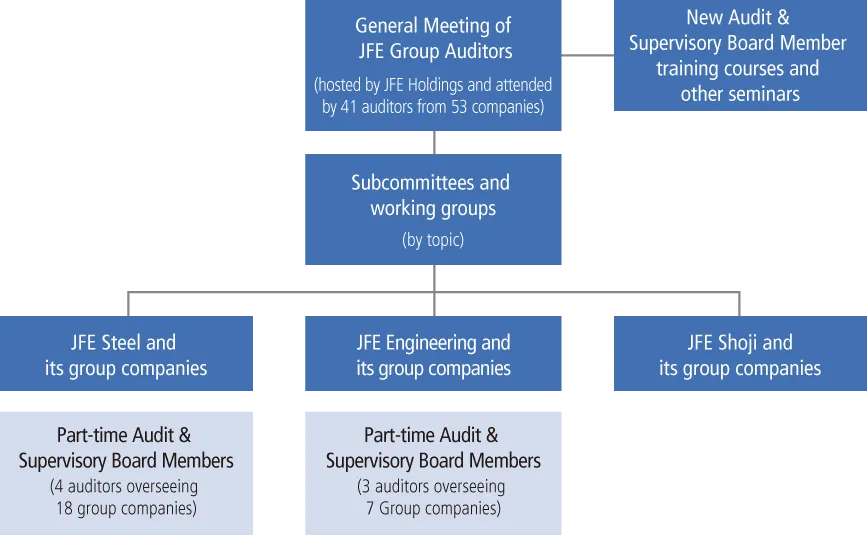
A total of 35 full-time Audit & Supervisory Officers (including full-time Audit & Supervisory Committee Members and full-time Audit & Supervisory Board Members) have been appointed to 30 companies, including JFE Holdings. In addition, operating company personnel are dispatched to Group companies as part-time Outside Audit & Supervisory Board Members. Each dispatched Audit & Supervisory Board Member audits an average of 1.5 Group companies (12 Members covered 44 companies).
The JFE Group Board of Auditors includes both full-time Audit & Supervisory Officers of each Group company and part-time Audit & Supervisory Board Members. Subcommittees and working groups created to address specific issues meet autonomously to share information, investigate issues and enhance understanding. The findings of the year’s activities are presented at the general meeting of JFE Group Auditors and used for audits.
These activities are executed to enhance overall auditing within the Group.
The JFE Group Board of Auditors
Cooperation between Audit & Supervisory Committee and Accounting Auditor
The Audit & Supervisory Committee holds meetings on a regular basis and as necessary with Ernst & Young ShinNihon, JFE’s outside accounting auditor, in which the latter presents its audit plan, completed work and results. The firm also presents an explanation of its quality management system. In turn, the Audit & Supervisory Committee explains their own audit plans and other matters and exchanges opinions to maintain close coordination.
Operating Company Governance
Some Directors and Corporate Officers of JFE Holdings serve concurrently as the Directors or Audit & Supervisory Board Members of operating companies to strengthen governance and information sharing across the Group. To strengthen governance, JFE Holdings’ managers attend each operating company’s General Meeting of Shareholders and Management Planning Briefing, receive reports on their activities, and discuss the managerial policies of subsidiaries.
Policy on Listed Subsidiaries and Listed Affiliates
-
Significance of having listed subsidiaries and affiliates based on group management approach and policies
To put into practice the Group’s corporate vision of contributing to society with the world’s most innovative technology, and to realize sustainable growth and enhancement of medium- to long-term corporate value, the Company forms a corporate group comprising companies with high expertise, divides business functions within the Group, and conducts businesses development outside of the Group. Within this corporate group, JFE Steel Corporation, a subsidiary of the Company, owns one listed subsidiary and four listed affiliates, described below.
For the listed subsidiary among them, the Company seeks an optimal structure based on the business relationship with JFE Steel Corporation, its parent company, and maintains its listing based on a comprehensive judgement that listing is necessary for the company’s growth and increasing the value of the Group as a whole, from the perspective of market recognition and credibility in funding, sales and marketing, and hiring.
In addition, the four listed affiliates maintain their listing as a means to enhance their competitiveness from the perspectives of market recognition and credibility in funding, sales and marketing, and hiring. JFE Steel Corporation holds some shares in the four companies because of associated benefits such as the exchange of steel manufacturing-related technologies and human resources.
【Listed Subsidiary】
JFE Systems, Inc. (Tokyo Stock Exchange, Standard Market)
The main business of JFE Systems includes system integration consisting of planning, designing, development, operation, and maintenance of information system, system construction utilizing solutions, and the company’s own products, and IT infrastructure solutions that support the business system.
Computer systems are an important foundation in the steel business that support overall business activities, including order acceptance, production, shipment, and quality management, and in using a variety of data. Guaranteeing the accumulation of know-how and the continuation of personnel exchanges by holding JFE Systems as a subsidiary will also be indispensable for maintaining the competitiveness of JFE Steel in pressing ahead with digital transformation.
JFE Systems, Inc.’s predecessor, Kawasaki Steel Systems R&D Corporation, was listed on the 2nd Section of the Tokyo Stock Exchange in March 2001. As of March 31, 2025, the JFE Group holds 68% shares of JFE Systems, Inc.
【Listed Affiliates】
Gecoss Corporation (Tokyo Stock Exchange, Prime Market)
Gecoss Corporation is mainly engaged in the rental and sales of temporary construction materials, as well as in design and construction of temporary works, etc. Gecoss Corporation’s predecessor, Kawasho Lease System Co., Ltd., was listed on the 2nd Section of the Tokyo Stock Exchange in August 1994 and was subsequently reassigned to the 1st Section of the Tokyo Stock Exchange in September 1996. As of March 31, 2025, the JFE Group as a whole currently holds 39.5% shares of the company.
Shinagawa Refra Co., Ltd. (Tokyo Stock Exchange, Prime Market)
At the Ordinary General Meeting of Shareholders held in June 2025, it was resolved that its trade name would change from Shinagawa Refractories Co., Ltd. to Shinagawa Refra Co., Ltd., effective October 1, 2025. Shinagawa Refra Co., Ltd. is mainly engaged in the manufacture and sale of refractories as well as engineering services such as furnace design and construction. Shinagawa Shirorenga, the predecessor of the company, was listed on the 1st Section of the Tokyo Stock Exchange in May 1949 and subsequently became an affiliate of JFE Steel Corporation. As of March 31, 2025, the JFE Group holds 34.9% shares of Shinagawa Refractories Co., Ltd.
Nippon Chuzo K.K. (Tokyo Stock Exchange, Standard Market)
Nippon Chuzo K.K. is mainly engaged in the formed and fabricated materials business to manufacture a variety of casting products and the engineering business to design and manufacture bridge components, etc. The company was listed on the 2nd Section of the Tokyo Stock Exchange in October 1961. As of March 31, 2025, the JFE Group holds 36.2% shares of Nippon Chuzo K.K.
NIPPON CHUTETSUKAN K.K. (Tokyo Stock Exchange, Standard Market)
NIPPON CHUTETSUKAN K.K. is mainly engaged in the manufacture and sale of ductile iron pipes and polyethylene pipes, as well as water pipe laying works. The company was listed on the 2nd Section of the Tokyo Stock Exchange in July 1962 and subsequently became an affiliate of JFE Steel Corporation. As of March 31, 2025, the JFE Group holds 30.0% shares of NIPPON CHUTETSUKAN K.K.
The aforementioned five companies are subject to rules different from those applicable to other consolidated subsidiaries and affiliates based on the guidelines of the Ministry of Economy, Trade and Industry and the Tokyo Stock Exchange regarding listed subsidiaries, and other measures are also taken so as to ensure that each of the companies conducts autonomous corporate activities exercising autonomy and flexibility. Each company also secures management independence as listed companies mainly by appointing outside directors who are independent from each company, JFE Steel Corporation and the Company and by establishing special committees composed of independent members such as independent outside directors, and makes sure that the interests of the said subsidiary or affiliate, as well as the interests of shareholders of the subsidiary or affiliate other than the Company, will not be unfairly impaired.
With regard to the adjustment and allocation of business opportunities and business areas for the listed subsidiary and affiliates, the Company respects autonomous management decisions made by each company, except in cases where such decisions have a significant impact on the Company’s consolidated financial statements.
In addition, each company independently raises and manages funds based on its own financial strategy. At present, the Company does not receive fund deposits from listed subsidiaries or listed affiliates.
With respect to matters necessary for the Group’s risk management, prior consultation and reporting are required from each company while securing their independent decision-making, so as to implement risk management as a member of the Group companies.
-
Measures to ensure the effectiveness of governance systems at listed subsidiaries and affiliates
Each company independently formulates its own proposals regarding the nomination of officers. JFE Steel Corporation fully respects the independence of each company and the decisions made by each company’s nomination committee, and exercises its voting rights with the aim of improving each company’s corporate value in the medium to long term.
To maximize the benefits of technological and personnel exchanges with each company, the Company and JFE Steel Corporation may recommend director candidates in some cases.
Furthermore, we shall regularly verify the significance of maintaining the listing of the listed subsidiaries and take necessary measures upon confirmation at its Board of Directors. The above details were verified and discussed at a Board of Directors meeting in May 2025.
Basic Policies for Strategic Shareholdings and Exercise of Related Voting Rights
All shares held by the Company are the shares of subsidiaries or affiliates. In principle, the Company’s wholly owned subsidiaries and operating companies, JFE Steel Corporation, JFE Engineering Corporation and JFE Shoji Corporation (hereinafter “Operating Companies”), do not hold listed stocks as strategic shareholdings. Strategic shareholdings, however, are allowed as an exception when holding the stocks of the Company is determined to be necessary for maintaining and achieving growth for the Group.
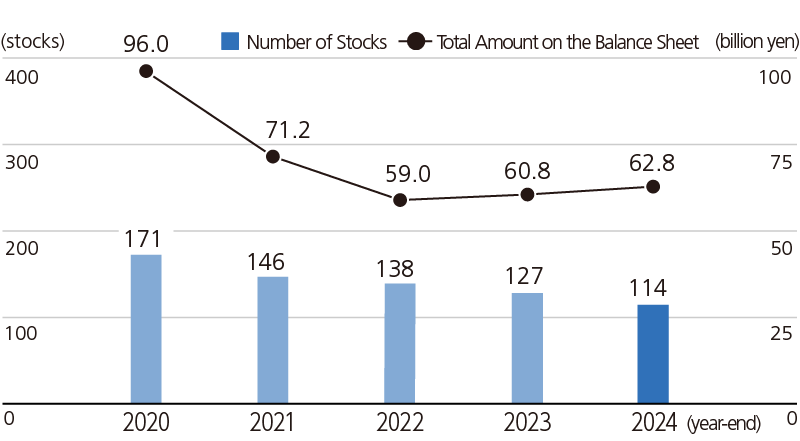
The Board of Directors regularly confirms the relative value of the strategic shareholdings and whether the benefits and risks of such holdings are commensurate with their capital cost, and sell shareholdings that are not significant or if there is a risk of damage to shareholder interests. In FY2024, the Company sold all or part of 11 listed stocks for 14.2 billion yen (market value). Furthermore, the Board of Directors regularly examines the significance of strategic holdings and the return on investment.
The exercise of voting rights of strategic shareholdings is decided upon reviews by operating companies on the content of the proposal and is appropriately implemented in a way that will maximize shareholder interest. To be specific, the content of the proposal is to be checked by the investment application department and the investment control department, and approval will be given to proposals which are considered not to pose any threat to the maximization of interest of these operating companies as shareholders.
Of the shares for investment purposes held by JFE Steel, which has the largest balance sheet amount for investment purposes posted in the consolidated financial statements of the company, those shares of the company held for purposes other than pure investments are shown below.
Number of Stocks and Amount Recorded on the Balance Sheet
| FY2020year-end | FY2021year-end | FY2022year-end | FY2023year-end | FY2024year-end | |
|---|---|---|---|---|---|
| Number of stocks (stocks) | 171 | 146 | 138 | 127 | 114 |
| Total amount recorded on the balance sheet (billion yen) | 96.0 | 71.2 | 59.0 | 60.8 | 62.8 |