Human Rights
Basic Policy
The JFE Group views respect for human rights as both a corporate social responsibility and a foundation of its business. Our determination to prevent discrimination in our business operations is clearly expressed in our Standards of Business Conduct, which we have consistently upheld. The JFE Group Human Rights Basic Policy, established as a standard to which Group companies and their officers and employees must comply, was revised in April 2023, and each operating company has reviewed and revised its procurement guidelines and related materials in line with this policy. Under the policy, we also seek cooperation from all stakeholders, including our supply chain, to respect and protect human rights.
We have been conducting human rights due diligence since FY2021 in accordance with the United Nations Guiding Principles on Business and Human Rights, while organizing seminars by external experts on human rights.
We will continue to promote initiatives for realizing a society in which human rights are respected and protected.
JFE Group Basic Policy on Human Rights
JFE hereby establishes the JFE Group’s Basic Policy on Human Rights based on the United Nations Guiding Principles on Business and Human Rights in order to promote Group-wide efforts to respect human rights and to fulfill its responsibilities to all stakeholders that it influences in the course of its business activities.
-
Basic approach to respect for human rights
We, the JFE group, support and respects the International Bill of Human Rights, which consists of the Universal Declaration of Human Rights and the International Covenants on Human Rights, as well as the International Labor Organization (ILO) Declaration on Fundamental Principles and Rights at Work.
We believe that respect for human rights is a corporate social responsibility and a foundational aspect of our operations. In addition to clearly stating and implementing our policy for respecting all members of the company and the general public and refraining from any form of discrimination in our corporate activities, we implement initiatives to ensure that we are not complicit in human rights abuses.
This policy represents our commitment to respect human rights based on the JFE Group Standards of Conduct.
-
Scope of application
This policy applies to all officers and employees of the JFE group. We also encourage all stakeholders, including members of our supply chain, to understand and support this policy.
-
Compliance with applicable laws
We comply with the laws and regulations of Japan and all other countries and regions where we operate, but if there is any conflict with internationally recognized human rights and regulations, we seek ways to respect internationally recognized human rights as much as possible.
-
Human rights due diligence
We identify negative impacts on human rights and utilize our internal mechanisms for human rights due diligence to prevent or mitigate such impacts.
-
Corrections and remedies
We maintain reporting contact points for receiving reports from both internal and external sources regarding negative impacts on human rights caused by any of our business activities. If we are made aware that we have caused or been involved in a negative impact on human rights, we will follow the necessary procedures to correct and remedy the problem.
-
Education
We provide education on respecting human rights to ensure that all of our officers and employees understand and implement the company’s basic policy.
-
Oversight
The JFE Group Sustainability Council, chaired by the President of JFE Holdings, Inc., oversees compliance with this policy and the implementation status of initiatives referred to herein.
-
Dialogue and consultations with stakeholders
Among the initiatives taken under this policy, we utilize outside experts as well as engage in discussion and consultation with internal and external stakeholders.
-
Information disclosure
We appropriately disclose all relevant information about our initiatives concerning respect for human rights and the progress of such initiatives via JFE group websites and other means.
-
Business-related human rights issues
-
Non-discrimination and equality under the law
We respect every individual connected with our corporate and business activities and do not discriminate on the basis of race, nationality, ethnicity, creed, religion, social status, lineage, age, gender, sexual orientation, gender identity, disability, or any other such factor.
-
Engaging with business partners
We seek the cooperation of all of our business partners in initiatives to respect and protect human rights in order to contribute toward creating a society in which the rights of all humans are respected and protected.
-
Harassment
We do not engage in any kind of harassment based on gender, status, or any other factors, including through language or behavior that offends or violates the dignity of others.
-
Forced labor and child labor
We never use forced labor or child labor in any country or region. We also do not tolerate or sanction any form of modern slavery, including bonded labor and human trafficking.
-
Occupational health & safety and appropriate working environments
In accordance with the fundamental idea that safety is our top priority above all else, we pursue health and safety in all of our activities and strive to create safe, healthy workplaces where all employees feel assured that their physical and mental health is protected.
-
Working hours and livable wages
We comply with all laws and regulations concerning working hours and wages applicable in the countries and regions where we operate. We work to ensure wages that allow employees to enjoy an adequate standard of living.
-
Right to freedom of association and collective bargaining
We respect employee rights to freely associate and collectively bargain in accordance with the laws and collective bargaining agreements in each country. In addition to taking into account each country’s laws and labor practices, we work to build sound labor-management relations and resolve problems by engaging in sincere and constructive dialogue with employees in accordance with international norms.
-
Rights of local and indigenous peoples
We respect and give due consideration to local people’s land rights, access to water, safety and health as well as the rights of indigenous peoples in regions where we operate.
-
Established: April 2018
Revised: April 2023
JFE Holdings, Inc.
This policy revision was formulated with the assistance of human rights experts and approved at the JFE Group Sustainability Council chaired by the President of JFE Holdings, Inc. Amendments to the policy have also been reported to the Board of Directors.
Structure
Promoting Human Rights
Governance Structure for Human Rights Awareness Promotion
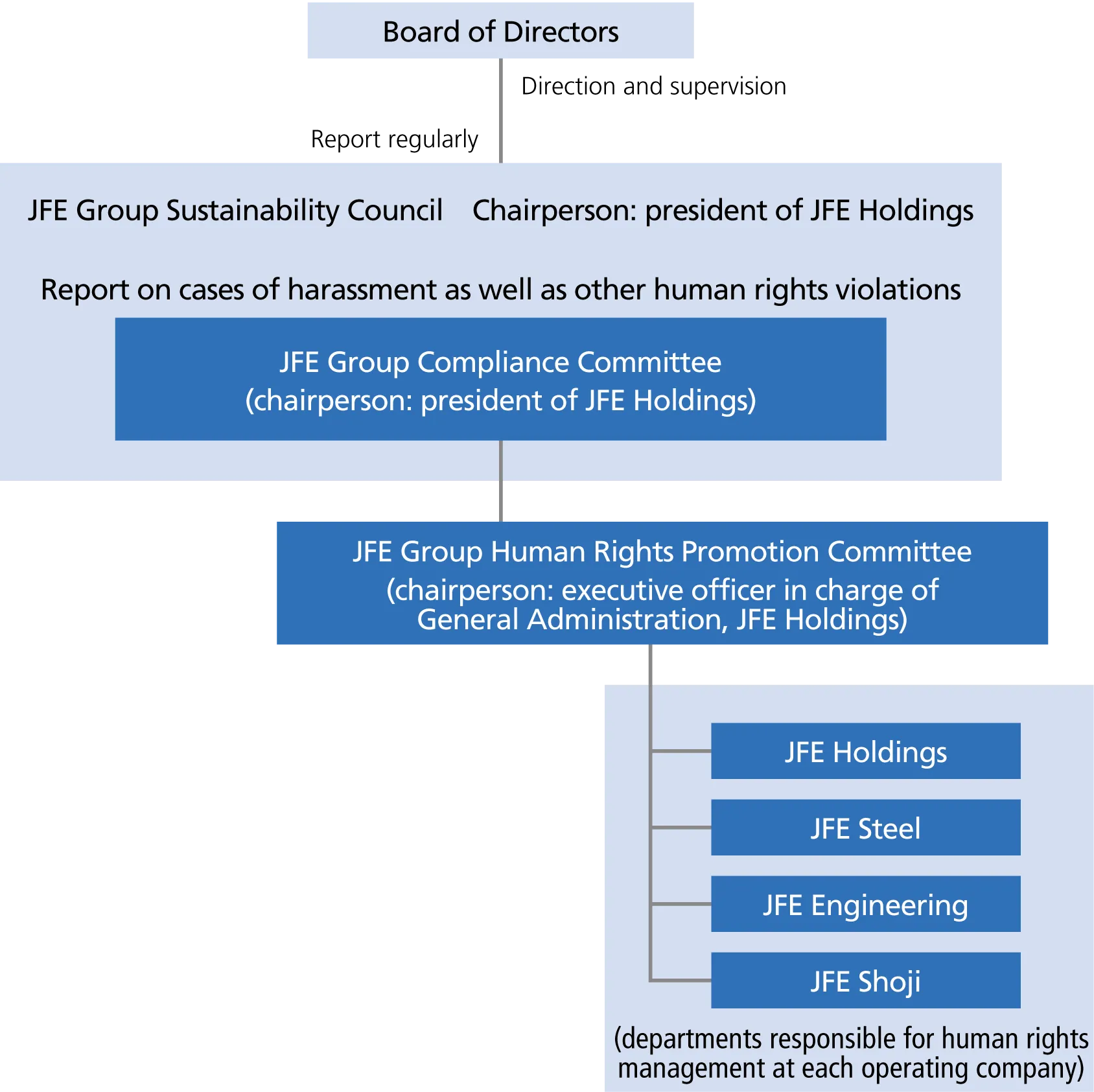
In order to steadfastly focus on human rights initiatives, we formulated Groupwide policies at the JFE Group Sustainability Council, chaired by the President and CEO of JFE Holdings and reports periodically to the Board of Directors for guidance and supervision. In addition, we established the JFE Group Human Rights Promotion Council, chaired by the corporate officer of JFE Holdings under the JFE Group Compliance Committee, chaired by the President and CEO of JFE Holdings, which allows us to regularly share information with departments responsible for human rights issues that have been set up at each operating company.
Remedy Mechanisms
We have been a full member of the Japan Center for Engagement and Remedy on Business and Human Rights (JaCER) since April 2025. The Company accepts reports, complaints, and consultations on human rights issues from stakeholders across the supply chain through JaCER’s non-judicial Engagement and Remedy Platform, which complies with the UN Guiding Principles on Business and Human Rights. Using this third-party contact point ensures fairness and transparency while addressing essential human rights issues and also safeguarding anonymity and confidentiality. Although one report filed with JaCER between April and July 2025 was deemed unrelated to human rights, JaCER provided feedback to the reporter and the matter was closed.
In addressing all human rights risks, we emphasize communicating with stakeholders through such initiatives as setting up a Corporate Ethics Hotline at each operating company and an independent law firm as an external contact point, as well as dedicated consultation desks on harassment issues at major offices, all of which accept anonymous reporting and consultation on human rights and related issues. In FY2024, a total of 314 cases were handled through the Corporate Ethics Hotline and harassment consultation desks at JFE Holdings, operating companies, and Group companies.
The operational status of these help desks and reports of harassment as well as other human rights violations are regularly reported to the JFE Group Sustainability Council and Board of Directors, including progress of investigations, findings, corrective measures, and recurrence prevention initiatives. Reports are also periodically submitted to the Board of Directors, thereby providing guidance and supervision.
- JaCER Grievance Form
- Development of the Whistleblowing System
- Governance Data: Corporate Ethics Hotline and Harassment Consultation Desks
Targets and Results
Recognizing that contributing to the realization of a society in which the human rights of each and every individual are respected and protected is not only a corporate social responsibility but also a foundational principle of management, the JFE Group upholds respect for human rights across the supply chain as a key management issue and promotes its efforts by setting KPIs.
Human Rights Due Diligence
The JFE Group has been committed to human rights due diligence based on the United Nations Guiding Principles on Business and Human Rights since FY2021.
Group’s Past Initiatives and Future Plans
| Overview | |
|---|---|
| FY2021 |
|
| FY2022 |
Expanding Human Rights Due Diligence to Group Companies
|
Establishing a Human Rights Risk Management System for Suppliers
|
|
| FY2023 |
Revised the JFE Group Human Rights Basic Policy (established in 2018)
|
Expanding Human Rights Due Diligence to Group Companies
|
|
Establishing a Human Rights Risk Management System for Suppliers
|
|
| FY2024 |
Expanding Human Rights Due Diligence to Group Companies
|
Establishing a Human Rights Risk Management System for Suppliers
|
|
| FY2025 (plan) |
Expanding Human Rights Due Diligence to Group Companies
|
Establishing a Human Rights Risk Management System for Suppliers
|
Human Rights Due Diligence Process
Human Rights Due Diligence Process
-
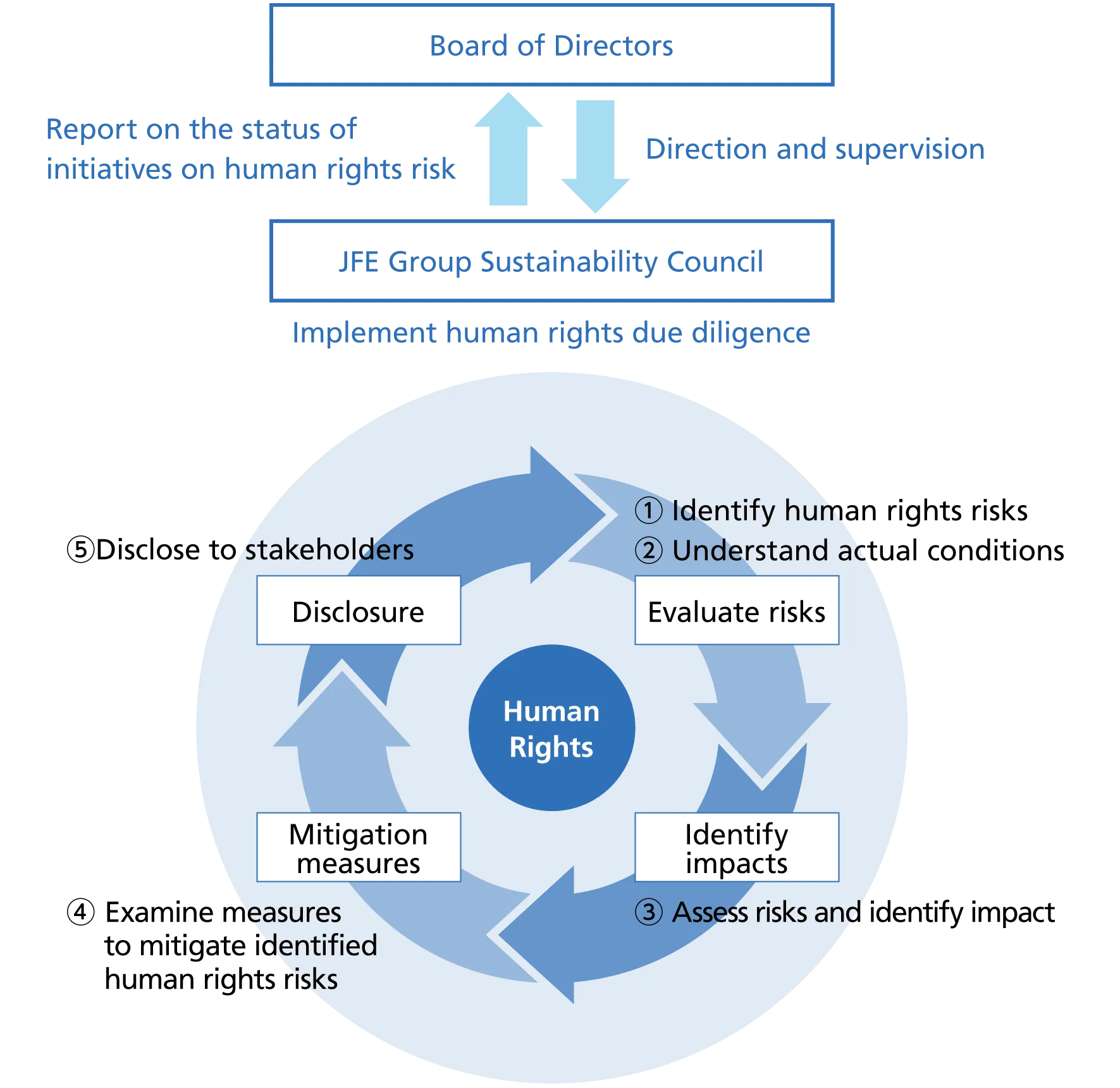
Identify human rights risks
We created a long list of human rights risks by referring to international norms and guidelines. Then, taking into account human rights risks specific to the industry, regional characteristics, and other relevant factors, we identified human rights risks related to the Group and its supply chain by stakeholder, such as employees and suppliers, including women, children, and local residents
International norms and guidelines referenced:
United Nations Guiding Principles on Business and Human Rights, International Bill of Human Rights, ILO’s Core Labor Standards, OECD Guidelines for Multinational Enterprises, Ten Principles of the UN Global Compact, GRI Standards, FLA Workplace Code of Conduct, and CHRB Key Industry Risks
15 human rights issues to consider:
Compliance with standards and guidelines for respect for human rights demanded by international norms Avoiding complicity in human rights abuses, compliance, social security, and fair competition Prohibition of discrimination and equality before the law Access to remedy Thorough supplier management Harassment and abuse Women’s rights Child labor Forced labor Occupational health and safety Working hours Appropriate working environment Wages that guarantee a decent standard of living Freedom of association and the right to collective bargaining Rights of indigenous and local people -
Investigate current status
We ascertained the current status of the risk management system and activities by examining our disclosure of policies on child labor, forced labor and various other human rights risks, such as the JFE Group Human Rights Basic Policy and the Basic Procurement Policy of each company, our whistleblowing system for ensuring access to remedial action, our initiatives on compliance including prevention of corruption, and other initiatives, systems and rules concerning internal and external human rights issues.
-
Assess risks and determine impacts
We assessed the risks of the identified human rights issues to be considered, based on the severity of impact and likelihood of occurrence, and determined the status of our initiatives on respecting human rights through written surveys and interviews in order to better identify that status in our future endeavors. During the risk assessment, we also determined the adverse impacts of human rights risks on the JFE Group and its stakeholders.
STENSHMap of Key Human Rights Risks
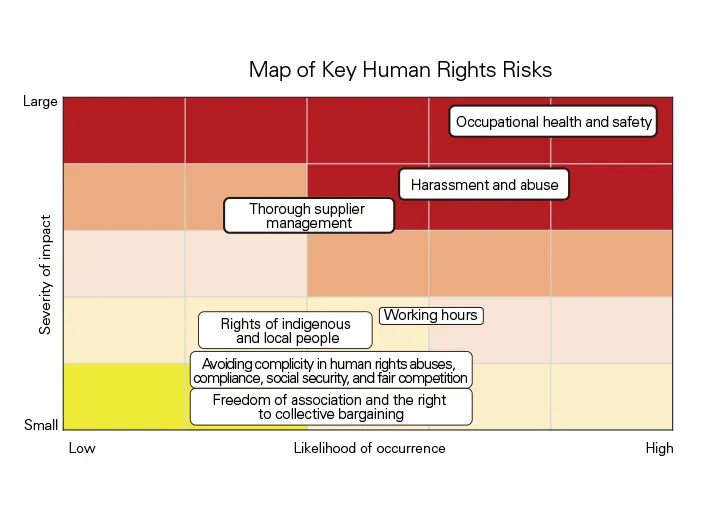
Human rights risks identified as particularly high risk and requiring action:
- Occupational health and safety
- Harassment and abuse
- Thorough supplier management (establishment of a human rights risk management system for the entire supply chain)
-
Consider mitigation measures for identified human rights risks
We implement mitigation measures for the identified human rights risks, including response as well as preventive and corrective measures and promotion systems. For occupational health and safety and harassment, we continue to strengthen our efforts to eliminate accidents and harassment using KPIs.
To create a sustainable and resilient supply chain, we are establishing a human rights risk management system encompassing the entire supply chain. We will also conduct surveys on the human rights risks of suppliers by determining the priority of the surveys based on the severity of the impact of such risks and the likelihood of their occurrence.
-
Information disclosure to stakeholders
We disclose the JFE Group Human Rights Basic Policy, guidelines for procurement at each operating company, and other related information on our website to communicate our initiatives to respect human rights, including human rights due diligence, and their status to our stakeholders.
FY2024 Initiatives
Expanding Human Rights Due Diligence to Group Companies
① STENSHDomestic Group Companies
We conducted a review of how to roll out supplier surveys at major domestic Group companies, including the methods and schedule for future expansion.
② STENSHOverseas Group Companies
We conducted human rights risk surveys of approximately 50 high-priority overseas Group companies and provided feedback on the results.
The initiatives of each operating company are as follows.
ST
At JFE Steel, we conducted assessments at three high-priority overseas Group companies in Thailand, Indonesia, and Brazil, taking into account such factors as equity ratio, company size, and human rights vulnerability. Reviewing the results, we found deficiencies in management systems and preventive and remedial frameworks for certain human rights issues, such as the prohibition of discrimination, equality under the law as well as procurement practices. Accordingly, JFE Steel provided feedback on the results and shared examples of remediation measures. Each company is now working on such actions as strengthening systems and revising regulations.
EN
At JFE Engineering, we conducted human rights risk assessments at three high-priority overseas Group companies in countries with elevated human rights risks in the Philippines, India, and Thailand, focusing on the occurrence of human rights risks and the effectiveness of management systems. We found deficiencies in preventive and remedial frameworks for certain human rights issues, including harassment and working hour management. Accordingly, JFE Engineering provided feedback on the survey results and shared examples of ways to improve, and is making progress in mitigating human rights risks.
SH
At JFE Shoji, we conducted human rights risk assessments at 45 overseas Group companies, thereby completing surveys for all major overseas Group companies. After compiling the results, JFE Shoji has been providing feedback to each company through FY2025.
Establishing a Human Rights Risk Management System for Suppliers
In FY2024, we followed up with suppliers surveyed in FY2023 (①) and conducted a survey of 88 newly-covered suppliers of steel raw materials, environmental resources, and equipment and materials (②).
① STENSHFollow-up for Suppliers Surveyed in FY2023
- The details of the supplier selection method, survey method, and other aspects of the FY2023 survey are summarized below.
We conduct surveys and evaluations of high-priority suppliers using the Global Compact Network Japan’s CSR Procurement Self-Assessment Tool*, taking into account the characteristics of each business.
- * An assessment tool issued and published by the Supply Chain Subcommittee and consisting of 114 questions covering human rights, labor, fair business practices, and other areas.
Supplier Selection Method
FY2023
- Raw materials: Selected primary suppliers whose headquarters or production sites are in countries with high human rights risks*1 as well as secondary suppliers through JFE Shoji or JFE Minerals
➡About 50 of approx. 700 suppliers were surveyed - Materials: Selected manufacturers of critical materials*2 and their trading companies
➡About 180 of approx. 1,500 suppliers were surveyed
FY2023
- Selected suppliers based on the following criteria.
- 1.Suppliers whose headquarters or production sites are in countries with high human rights risks
- 2.Suppliers that provide high-risk raw materials*3
- 3.Key suppliers with a high level of business dependency, such as business partners or sole-source suppliers for technical reasons
- 4.Suppliers with a relatively large business scale and high order value*4
- ➡About 100 of approx. 3,700 suppliers were surveyed
FY2023
Selected high-priority suppliers of steel raw materials, environmental resources, and equipment that supply products to JFE Steel and JFE Engineering
➡About 70 of approx. 2,400 suppliers were surveyed
- *1 Selected based on published indexes (such as the Human Rights Index compiled by Our World in Data) and advice from an advisory body
- *2 Materials affecting the quality of steel products, selected by the relevant departments (e.g., refractories, rolls, chemicals)
- *3 Selected based on advice from an external advisory body, targeting products that use silicon, lithium, palm oil, and other materials as their primary raw materials
- *4 Companies with capital of at least ¥10 million and annual transactions of at least ¥1 billion with at least 100 transactions per year
Supplier Assessment and Evaluation Method
We use the CSR/Sustainable Procurement Self-assessment Tool Set developed by the Global Compact Network Japan to check whether suppliers have mechanisms in place for CSR and human rights, including policies, systems, implementation outcomes, and corrective measures.
We set “high risk questions” in the tool questionnaire in accordance with the Priority Human Rights Risk Map and assessed the respective characteristics of each business, then conducted follow-ups with suppliers that scored poorly on those items.
Examples of high-risk questions
Labor:
- Payment of fair wages
- Fair management of working hours, leave, and paid holidays
- Prohibition of forced labor
- Prohibition of child labor
Supply chain:
- Measures to address conflict minerals
- Operating companies are taking the following actions.
STSH
JFE Steel and JFE Shoji sent follow-up tools* to approximately 40 suppliers who needed to take corrective action. As a result, suppliers submitted written confirmation that they were implementing the following major improvements.
- Suppliers that lacked mechanisms for paying fair wages confirmed they had established internal rules and were monitoring compliance.
- Suppliers that had lacked a policy for preventing the procurement of conflict minerals confirmed they had formulated the necessary policy and developed procedures for communicating it to their own suppliers.
JFE Steel and JFE Shoji will continue to engage with suppliers that have not yet confirmed improvements, and will follow up through such actions as future surveys.
EN
JFE Engineering sent follow-up tools to approximately 40 suppliers who needed to take corrective action. The status of improvements will be monitored through such measures as upcoming surveys on human rights risks.
- * A document that defines and explains issues related to high-risk questions, provides specific examples of risks, and summarizes initiatives undertaken by the Group
② SHSurvey of 88 newly covered suppliers of steel raw materials, environmental resources, and equipment and materials
JFE Shoji surveyed 88 newly covered suppliers of steel raw materials, environmental resources, and equipment and materials. Details of the supplier selection method are provided below (using the same survey and evaluation method as in FY2023).
We conduct surveys and evaluations of high-priority suppliers using the CSR/Sustainable Procurement Self-assessment Tool Set of the Global Compact Network Japan, taking into account the respective characteristics of each business.
Supplier Selection Method
FY2024
- Suppliers of steel raw materials, environmental resources, and equipment and materials that meet any of the following criteria were selected.
- 1.Suppliers whose headquarters or production sites are located in countries with high human rights risks*1
- 2.Suppliers that provide high-risk product categories*2
- 3.Suppliers that fall within the top 75% in procurement value based on purchase amount
- ➡About 88 of approx. 2,400 suppliers were surveyed
- *1 Selected based on publicly available indexes (such as the Human Rights Index compiled by Our World in Data) and advice from an advisory body
- *2 Selected from lists published by Japan’s Ministry of Economy, Trade and Industry (METI) and by the U.S. Department of Labor and Department of State
Future Initiatives
We will promote initiatives to correct and mitigate identified human rights risks and take the following actions to expand our human rights due diligence. To steadily advance our initiatives, we will conduct appropriate evaluations and make improvements under the supervision of the JFE Group Sustainability Council and Board of Directors, thereby enhancing effectiveness.
Expanding Human Rights Due Diligence to Group Companies
1. STENSHDomestic Group Companies
In FY2025, we will continue to examine methods and schedules for the future rollout of supplier surveys at major domestic Group companies.
2. STENSHOverseas Group Companies
In FY2025, we will conduct human rights risk surveys at six overseas Group companies for the first time and provide feedback to overseas Group companies that had been surveyed in FY2024.
The initiatives of each operating company are described below.
ST
JFE Steel will conduct human rights risk surveys at three major consolidated overseas Group companies in the Philippines, United States, and Singapore.
EN
JFE Engineering will conduct human rights risk surveys at three major overseas Group companies in Malaysia, Indonesia, and Germany.
SH
JFE Shoji will provide feedback on the survey results to the 45 overseas Group companies that had been surveyed in FY2024.
Establishing Human Rights Risk Management System for Suppliers
In FY2025, each operating company plans to implement the following initiatives.
ST
JFE Steel will provide opportunities to explain global trends in business and human rights as well as its own policies to small and medium-sized suppliers that showed a high proportion of responses indicating “no initiatives or corrective mechanisms in place” for high-risk questions in the previous survey. In addition, it will conduct a second round of surveys targeting around 200 priority suppliers selected using the same criteria as in the FY2023 survey.
EN
JFE Engineering will conduct a second round of surveys in FY2025 for around 70 priority suppliers, mainly those surveyed in FY2023.
Given that JFE Engineering selects suppliers on a project-by-project basis with some turnover every year, the company also launched a program in July 2025 to screen new suppliers via questionnaire to confirm the presence of any supply-chain risk incidents and whether corrective actions* have been taken. This process informs decisions on transactions and remedial actions.
- * Risk items include prevention of bribery of public officials, compliance with antitrust laws, prohibition of forced labor, prohibition of child labor, and efforts related to conflict minerals.
SH
In FY2025, JFE Shoji will conduct a human rights survey for approximately 20 newly covered steel suppliers. Details of the supplier selection method are provided below (using the same survey and evaluation methods as in FY2023). This will complete the first round of surveys of JFE Shoji’s major suppliers.
We conduct surveys and evaluations of high-priority suppliers using the CSR/Sustainable Procurement Self-assessment Tool Set of the Global Compact Network Japan, taking into account the respective characteristics of each business.
Supplier Selection Method
FY2025
- Steel suppliers that meet any of the following criteria were selected.
- 1.Suppliers whose headquarters or production sites are located in countries with high human rights risks*1
- 2.Suppliers that provide high-risk product categories*2
- 3.Suppliers that fall within the top 75% in procurement value based on purchase amount
- ➡About 20 of approx. 400 suppliers are scheduled to be surveyed
- *1 Selected based on published indexes (such as the Human Rights Index compiled by Our World in Data) and advice from an advisory body
- *2 Selected from lists published by Japan’s Ministry of Economy, Trade and Industry (METI) and by the U.S. Department of Labor and Department of State
Human Rights Promoting Activities
To consistently maintain our activities to respect human rights and raise employee awareness, we conduct human rights training courses, offer guaranteed equal employment opportunities, promote fair human-resource management, and actively prevent workplace harassment. Our training courses encourage employees to develop a thorough understanding of the JFE Group Human Rights Basic Policy and the respect for human rights expected of a company in the international community. To this end, we continuously monitor and following up on seminars against a KPI focused on attendance rate (attendance rate in FY2024: 100%).
We seek to prevent sexual harassment, power harassment, and other forms of harassment by addressing these issues in company regulations, displaying posters in workplaces, and regularly conducting harassment prevention training for all employees as well as by position (including management), individual offices, and executives. These programs include sessions that raise awareness and provide practical training using case studies to address everyday communication, the use of reporting and consultation channels if harassment occurs, and appropriate responses.
In addition, we invited an outside attorney to conduct a seminar for corporate ethics hotline and harassment consultation desk staff (those who receive reports, including management) within the JFE Group. We regularly organize these training sessions for hotline and consultation desk personnel, including content on confidentiality obligations when receiving reports and case studies (participants: approx. 200 in FY2020, approx. 300 in FY2022, and approx. 300 in FY2024).
Furthermore, we actively support and take part in initiatives undertaken by public organizations and groups promoting human rights as well as groups in which private enterprises participate, such as the Industrial Federation for Human Rights, Tokyo and the Corporate Federation for Dowa and Human Rights Issue, Osaka. By attending seminars and workshops sponsored or supported by such organizations and groups, we have become increasingly aware of human rights trends and challenges as well as issues specific to Japanese business. We then apply this knowledge in JFE human-rights awareness training programs and related initiatives.
Respecting the Rights of Workers
The JFE Group adheres to the laws and regulations of various countries as well as collective agreements. It also respects the rights to freedom of association as well as their right to collective bargaining.
Upper management, including the president and the representative of the union, meets regularly to discuss matters such as management issues, work life-balance, working environments, and working conditions. By conducting earnest labor-management consultations, we strive to create a vigorous workplace while working to maintain healthy and sound labor-management relations.
The JFE Group complies with laws and regulations related to salary payments and sets salaries above the minimum wage designated by country, region and industry sector. In addition to meeting legal requirements concerning the upper limits for overtime and other mandates, the JFE Group strives to improve employees’ work engagement by providing them with one of the top levels of employment conditions in the industry as well as performance-based bonuses linked to company profits.
We regularly review the wage situation in each region and business sector and engage in honest discussions with the labor union to ensure a fair return to our employees while also paying due consideration to management and business performance.
Respect for Freedom of Expression
The JFE Group upholds basic human rights in its Human Rights Basic Policy and is committed to respecting and protecting the human rights of each individual throughout its corporate activities. We pay due care to prevent violations of the freedom of expression, as recognized by the International Covenant on Human Rights and other international conventions, and to fully protect the right to privacy.
Respect for Children’s Rights
The JFE Group supports the Convention on the Rights of the Child and Children’s Rights and Business Principles and will seek to eliminate child labor and respect every child’s right to survival, right to development, right to protection and the right to participation, the four pillars of the Convention on the Rights of the Child.
The JFE Group Human Rights Basic Policy upholds recognizing the diverse values held by each individual in all aspects of corporate activity as well as respecting and protecting the human rights of each person in compliance with international conventions. It also explicitly prohibits child labor and forced labor. To promote concrete initiatives, the JFE Group has focused on nurturing the next generation as a key area of its public service and is engaged in activities that support the sound development of younger generations.
Endorsing and Participating in External Initiatives
We are a member of the Global Compact Network Japan, an organization that promotes Global Compact activities in Japan, in support of the Ten Principles of the United Nations Global Compact, related to the protection of human rights, the elimination of unfair labor practices, environmental protection, and the prevention of corruption. We also participate in subcommittee activities of the Global Compact Network Japan and promote our own initiatives based on exchanging information with participating companies and organizations.
Respecting Human Rights across the Supply Chain
ST Compliance with the JFE Steel Procurement Guidelines and Responsible Procurement of Raw Materials
In accordance with the JFE Group Human Rights Basic Policy, JFE Steel established the JFE Steel Procurement Guidelines in 2023, which incorporate more extensive and specific information on sustainability in general, in addition to respect for human rights. To promote sustainability initiatives throughout the supply chain, we disclose the guidelines on our website and request compliance from our suppliers.
In terms of raw material procurement in particular, there is concern that tin, tantalum, tungsten, gold, and cobalt provide a funding source for militias causing human rights violations and environmental destruction. Therefore, JFE Steel purchases them only after confirming that they have not been mined in conflict-affected or high-risk areas, in accordance with Japanese and overseas regulations governing the responsible procurement of minerals as well as international rules.
For JFE Steel Procurement Guidelines, please refer to:
EN Promoting Initiatives to Respect Human Rights in Cooperation with Suppliers
In line with the JFE Group Human Rights Basic Policy, JFE Engineering has established its Purchasing and Procurement Policies and is promoting sustainable procurement in cooperation with suppliers to advance initiatives related to respect for human rights. It also asks suppliers to respect basic human rights, eliminate all forms of discrimination, and strive to create a safe and comfortable working environment by establishing procurement guidelines while observing laws, regulations, and social norms in their business activities. The company ensures that these policies are clearly communicated throughout the supply chain by publicizing them on the company’s website.
For JFE Engineering’s Procurement Policy and Procurement Guidelines, please refer to:
SH Promotion of Respect for Human Rights in the Supply Chain
In line with the JFE Group Human Rights Basic Policy, the JFE Shoji Group has established the Basic Policy on Sustainability in the Supply Chain to promote joint efforts with suppliers in respecting human rights and advancing sustainability as a whole. To raise awareness throughout the supply chain, the policy is disclosed on the company’s website.
For JFE Shoji’s Basic Policy on Sustainability in the Supply Chain, please refer to: